
The Military Intelligence Connections Behind the JFK, Oswald Murders & Cover-up
Evidence points to an extraordinary concentration of military intelligence personnel in the JFK assassination story, from Life Magazine's Donald Jackson to the man who purchased Jack Ruby's gun.

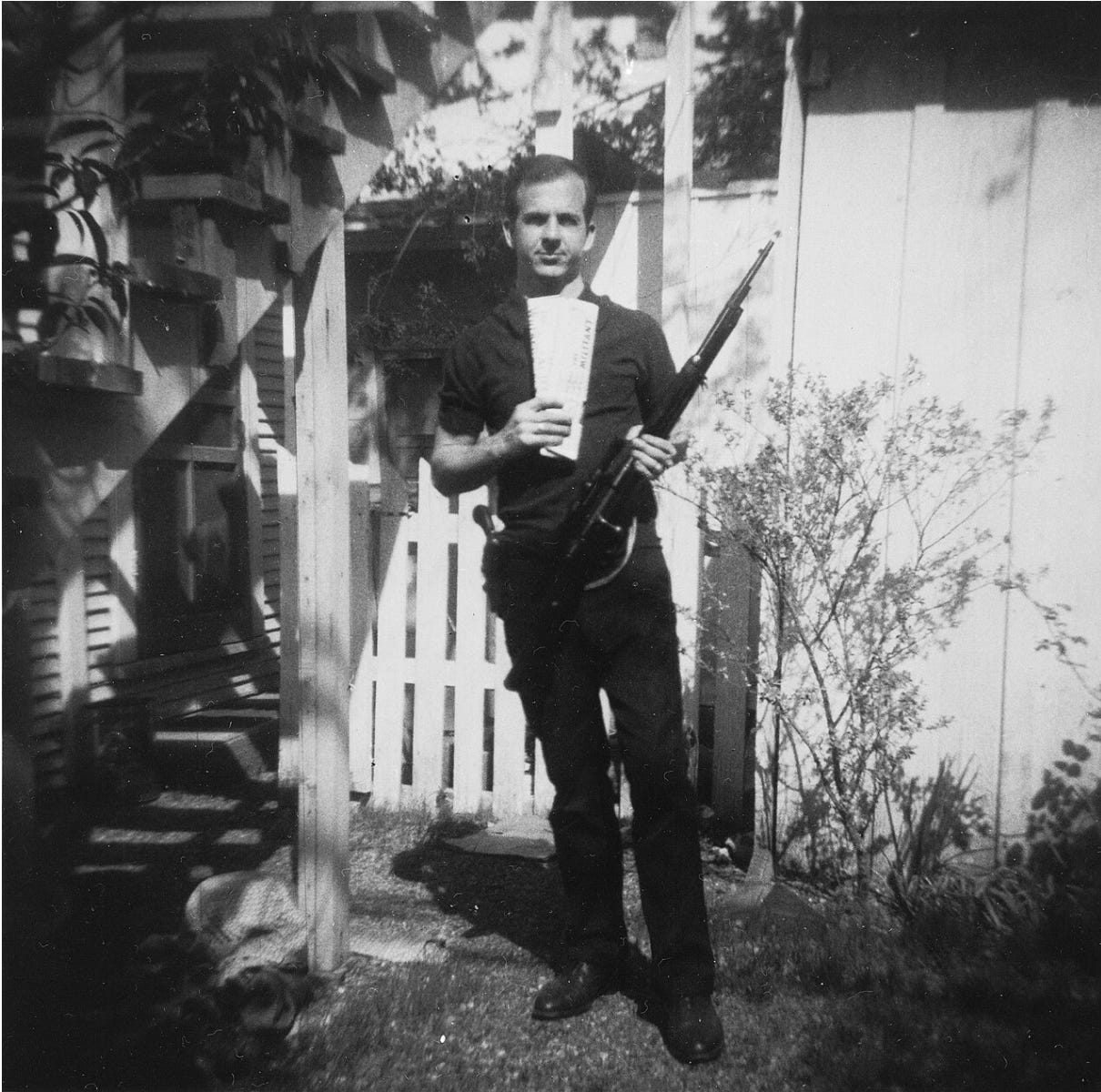

“Everybody in the intelligence field in this area knew Oswald. And everybody knew Ruby.” — Col. Rudolph M. Reich (Ret.), former Operations Officer of the U.S. Army 112th Intelligence Corps Group in Texas, to Timothy Wray, ARRB, July 24, 1996, pg. 3 (emphasis in original)
Introduction
This investigation began as a continuation of earlier research into the intelligence community’s involvement in promoting the Warren Commission’s Oswald “lone nut” narrative. There is much to still be discovered about that. When I subsequently pulled on one thread of that story — the links between Life Magazine reporter Donald Dale Jackson and the military intelligence (MI) community — something else was revealed: the presence of key figures in the assassination story with links to military intelligence, and in particular, the U.S. Army’s Counter-Intelligence Corps (CIC). This is a story taken up in part by others,1 but I think most people will find a number of new items in this article.
What kinds of MI presence were there? For instance, the Secret Service cars both immediately in front of and behind John Kennedy’s limo on November 22, 1963 carried former CIC agents, Winston Lawson2 and Clint Hill, respectively. The consul in Moscow who met with Oswald alone on his first visit to the U.S. embassy on October 31, 1959 was former CIA official and military intelligence (G-2) man, Richard Edward Snyder.3
The first federal agent that I was able to determine entered the Texas School Book Depository just after the assassination was James W. Powell, who was “a member of the 112th INTC [Intelligence Corps] Group,” which maintained an office in downtown Dallas, and had been close enough to Dealey Plaza to have heard the assassination gunshots (brackets in original). Powell’s presence opens the door to a long-simmering controversy over the presence or non-presence of local military intelligence officers in Dealey Plaza on the day of the assassination, a controversy that will be addressed later in this article.
According to a 1997 report by Timothy Wray of the Assassination Records Review Board (AARB), the 112th INTC “was directly subordinate to 4th [U.S. continental] Army, and in fact its headquarters was virtually side-by-side with 4th Army’s headquarters at Fort Sam Houston” in San Antonio. The 112th was initially a unit of the Army’s Counter Intelligence Corps, and was “enlarged to a counterintelligence group in 1957. It was renamed the 112th Intelligence Corps Group in 1961, though it went by the cover name ‘4th U.S. Army Operations Group’ until July, 1962. Its official mission was ‘to contribute to the operations of 4th U.S. Army through the detection of treason, sedition, subversive activity, and espionage and sabotage within or directed against the 4th U.S. Army and the area of its jurisdiction” (pg. 3, material in brackets added).
At the time of the assassination of President John Kennedy and the murders of Lee Harvey Oswald and Dallas police officer J.D. Tippet, the 112th INTC Group “had approximately 300 military personnel and 25 civilians assigned to it” (Ibid.). As we shall see, there was notable overlap with Dallas police force personnel. There was also the fact that the army unit was involved in domestic surveillance of civil rights and other political activists.
Returning to examples of military intelligence figures associated with the assassination, there was the mysterious John David Hurt, the man Lee Harvey Oswald tried to reach by phone when he was in custody in the Dallas jail. Hurt, who was disabled and perhaps mentally ill, seemed a strange choice to call, but one thing was clear — he had a background in intelligence as a CIC officer.
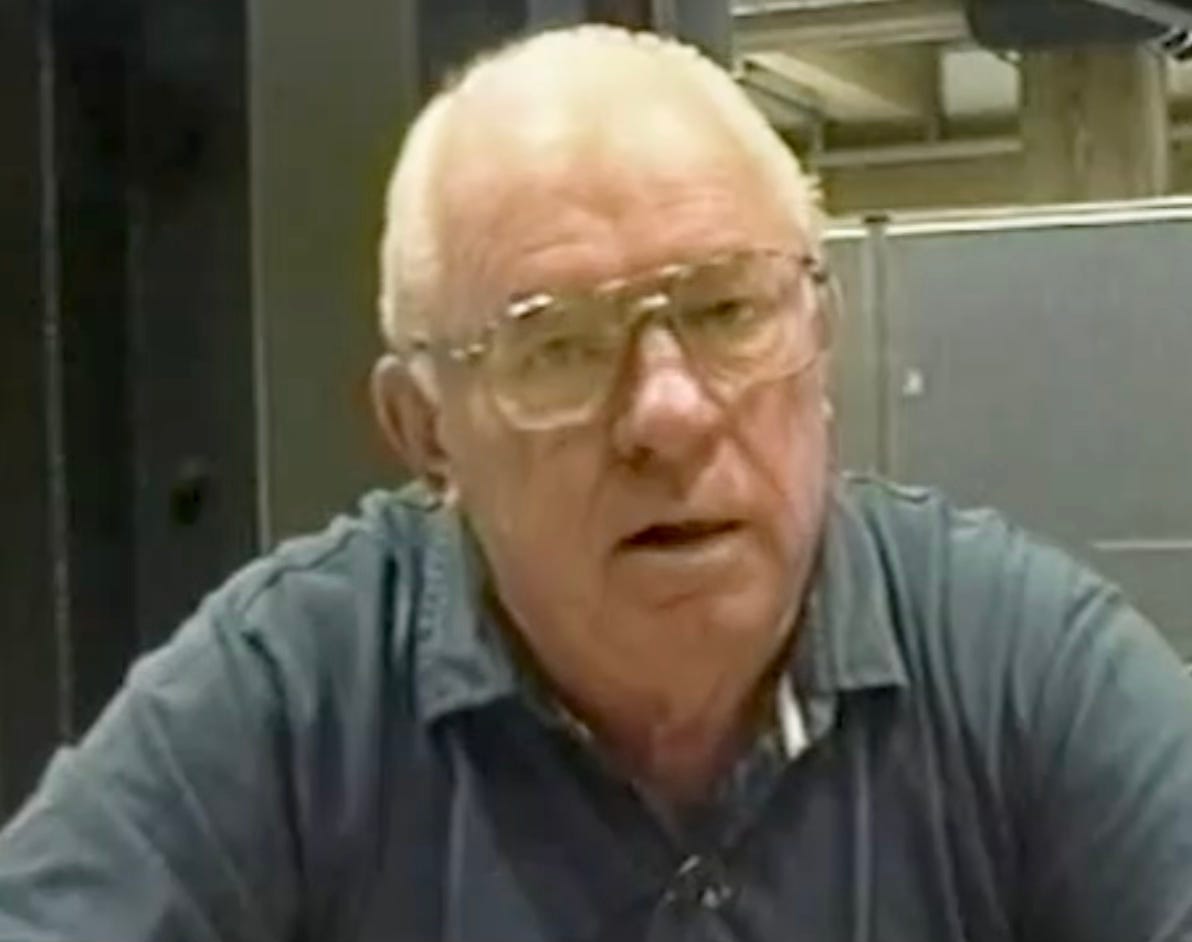
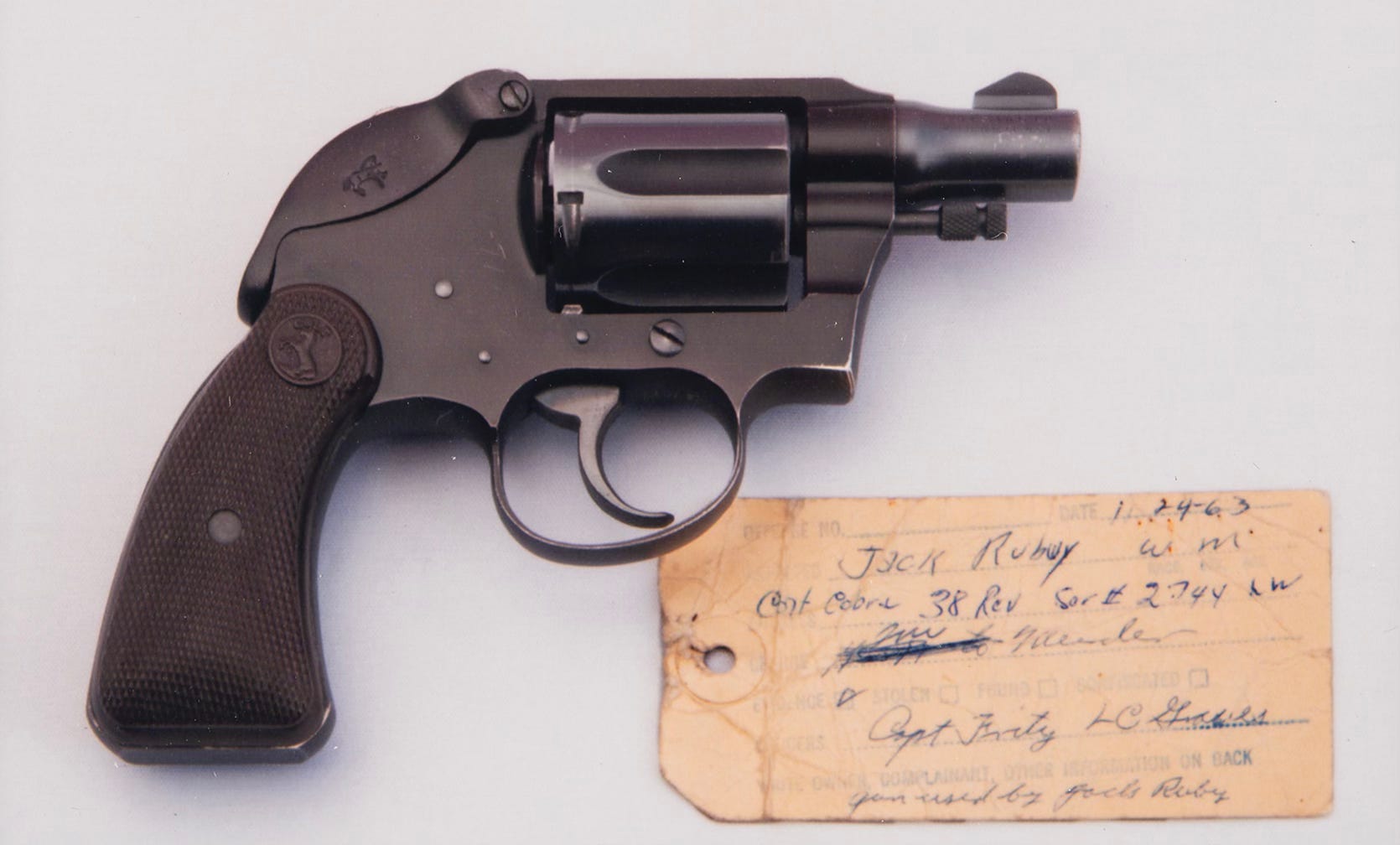
The cherry on top of this group was probably Joseph Cody, a Dallas police officer and former CIC agent, who by his own account said he knew Jack Ruby better than anyone else in Dallas (video, see 32:30 time-mark). He also claimed he was the first police official to interview Oswald, even before homicide detectives got a crack at him (26:55). And — what a coincidence is this! — he purchased specifically for Ruby the gun Jack Ruby would later use to shoot Lee Harvey Oswald.
Interestingly, Cody met Ruby approximately ten years before the JFK assassination while Cody was still “on assignment” for CIC, according to his interview with the FBI on December 16, 1963. Cody said he and Ruby bonded over their joint love of ice skating, and that they went ice skating together many times. So far as I can tell, no other source has ever mentioned Ruby’s predilection for ice skating. For some reason, Cody was never interviewed by the Warren Commission. He died in Dallas in 2008.
From Cody’s December 16, 1963 FBI report, which was listed as an exhibit in the Warren Report:
CODY stated he was in the Korean War and was assigned in the Counter Intelligence Corps. He stated that while on that assignment he had been assigned in Dallas part of the time and, during that time, had gone into the Silver Spur, The Carousel, and the Vegas Clubs, on several occasions [all clubs associated with Jack Ruby - JK].
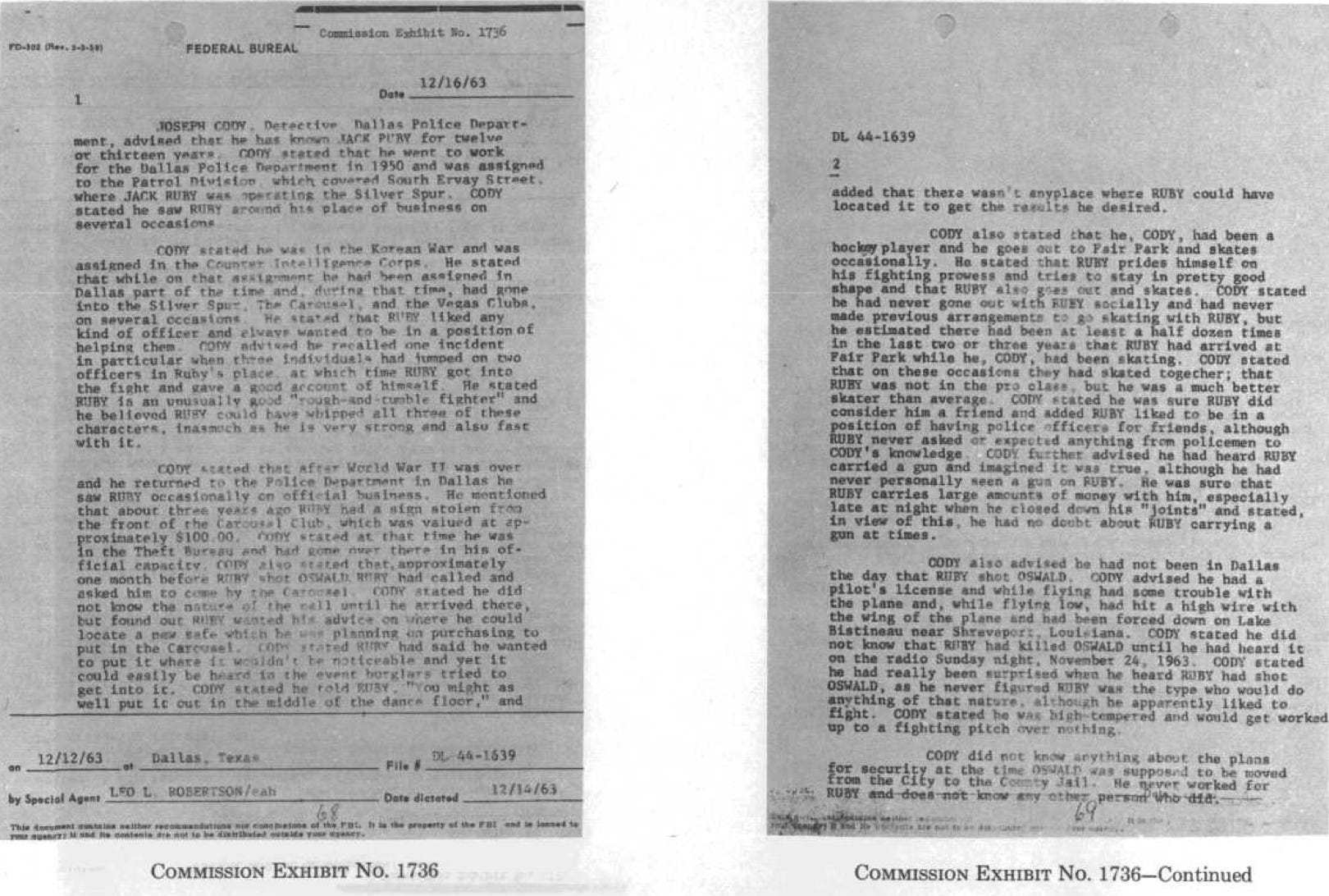
The FBI report also noted, “CODY stated that after World War II was over and he returned to the Police Department in Dallas he saw RUBY occasionally on official business.” It sure sounds as if Ruby was an informant or some kind of asset for Army intelligence. If Ruby had been an intelligence asset for CIC agent Cody, could their skating rendezvous have been a cover for meetings between an agent and his asset?
In addition, it seems worth mentioning that Jack’s older brother, Sam Ruby, told the Warren Commission that he (Sam) had worked for Army Air Force Intelligence while he was stationed at Langley Field in World War II. Sam indicated that his superiors knew Jack by name, and Sam’s reports were to be signed using a code name, “Johnny Newman,” addressed to his “Dear Brother Jack,” and mailed to “a certain box number in Newport News, Va., which was about 20 miles away from Langley Field….” (pg. 503).
A July 11, 2025 podcast at Fourth Reich Archaeology noted the Sam Ruby connection with Army intelligence and commented, “the fact that Jack Ruby was even as a very young man being used as a foil, as basically a straw man, a front for intelligence operations and psychological operations is another one of these pile of facts that are part of the evidence that stack up a mile high and draw extreme suspicion” (00:18:21 — link to transcript).
In fact, if we add up Sam Ruby, Joe Cody, and the many intelligence-linked officers at the Dallas Police Department (as will be discussed further on), not to mention Ruby’s connection to CIA psychiatrist Louis J. West, and the fact that in 1947 Jack also performed “information functions for the staff” of then Congressman Richard Nixon, Ruby seems surrounded by intelligence figures for much of his adult life.
I should also add Richard Case Nagell to the list of military intelligence figures around Oswald. Nagell had been in the CIC from approximately 1954 to 1959, and joined the CIA a few years later. He claimed to have known Lee Oswald while the latter was stationed in Japan. He also said that he had advance knowledge of the assassination and had been ordered by the KGB, for whom he allegedly was a double agent for the CIA, to warn Oswald about the plot.4
I only mention Nagell here because I think the list would be incomplete without him. However, the Nagell case is so convoluted, opaque, and mysterious that I cannot really link him with the other men listed above. It would take an entire article to sort out the different strands making up his story and take the reader too far afield from the main topics I aim to focus upon.
Finally, there was one other person with military intelligence credentials who claimed to have knowledge of the assassination, former Military Intelligence Service (MIS) agent Gary Underhill, who also worked in some capacity for the CIA. Interestingly, given the topic of the essay here, Underhill also worked as a pictorial journalist for Life Magazine from 1938-1942. After that he joined MIS, “working on technical and photgraphic headings for MIS publications, evaluation of intelligence, and enemy uniforms, insignia, weapons, etc.” According to a 1961 article in Der Spiegel, Underhill “had been employed by CIA as an arms expert during the Korean War” and helped supply “arms to various trouble spots.”
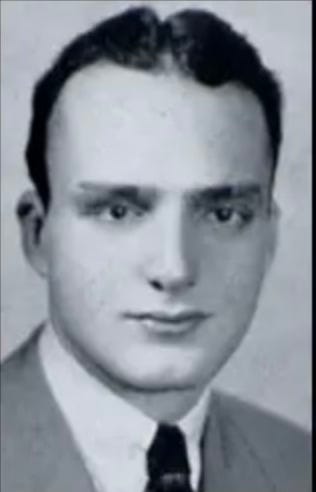
As quoted in a document released only last year under the JFK Records Act, an article in Ramparts Magazine in June 1967 told an incredible story about Underhill:
The day after the assassination, Gary Underhill left Washington in a hurry. Late in the evening he showed up at the home of friends in New Jersey. He was very agitated. A small clique within the CIA was responsible for the assassination, he confided, and he was afraid for his life and probably would have to leave the country. Less than six months later Underhill was found shot to death in his Washington apartment. The coroner ruled it suicide.”
As with Nagell, a full telling of the Underhill story is outside the scope of this article, though that doesn’t mean it isn’t relevant. I’ve included both Underhill and Nagell in this listing of military intelligence figures because both expressed special knowledge of the assassination. If they did know, did their knowledge come from military intelligence contacts? Or from within the CIA itself? Both Nagell and Underhill seemed quite nervous about what they knew about the assassination. Later on in this article, we will meet another military intelligence figure, Stephen Weiss, who also seemed worried about providing investigators information about what he knew about Dallas.
While CIA, CIC, MIS, FBI, etc. were all separate organizations, in practice their personnel would overlap, and they often worked together on assignment. As an example, a 1978 in-house history of the CIA’s Mexico City Station, written or overseen by Anne Goodpasture,5 and released to the House Select Committee on Assassinations, documented close work between the CIA, CIC and FBI. One case in particular called for CIA “to provide surveillance and investigative assets to CIC” (pg. 205 - PDF pg. 72).
As for CIC itself, it was disbanded by the Pentagon in 1961. Its human assets may have been sent here or there, but I assume many or most were sent into the newly created “Army Intelligence and Security Branch” (later renamed U.S. Army Intelligence and Security Command, or INSCOM).
“The conceptual centerpiece of the Warren Report”
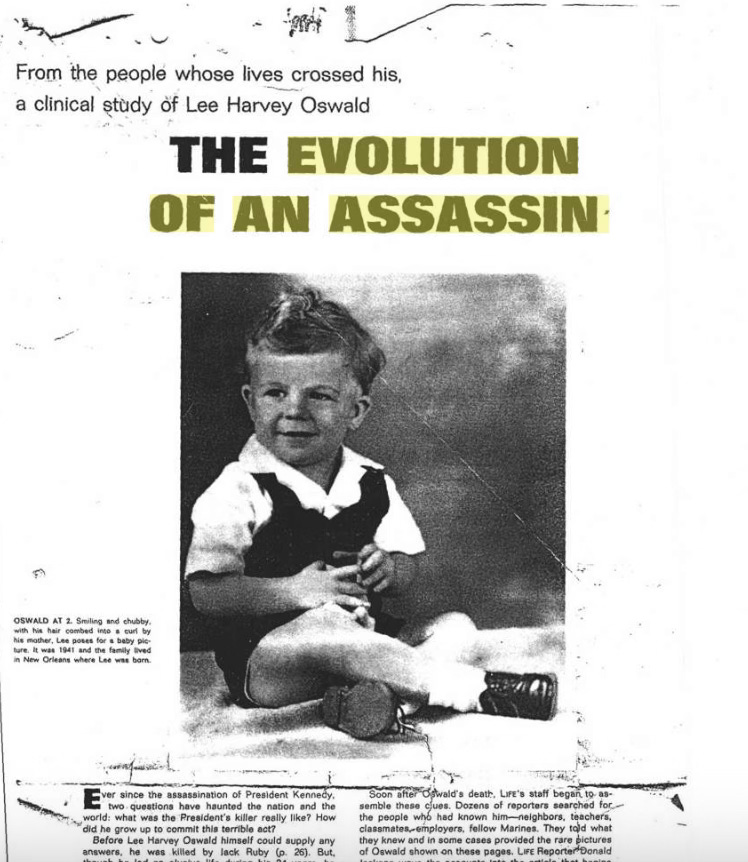
With so many military intelligence and CIA figures swirling around Oswald and Ruby, it’s not a great surprise to discover that the man who wrote the most early influential biography of Oswald, “The Evolution of An Assassin," published in Life Magazine on February 21, 1964, had only some three to four years earlier been a CIC agent. As can be seen in a National Archives reproduction of the article, its author, Donald Dale Jackson, or perhaps a Life editor, subtitled the work “a clinical study of Lee Harvey Oswald.” The magazine advertised “in full and extraordinary detail, the life of the assassin.”6
The word “clinical” promised a scientific, psychological, or psychiatric expert presentation that the article could not and did not have. In reality, it was a hatchet job that began with one premise: Oswald was “the president’s killer” (Pg. 68A).
But Lee Harvey Oswald had never been tried for the crime of killing John Kennedy, and therefore was obviously never convicted of the crime either. There are plenty of articles, books, and essays that have argued how Oswald did not get a fair shake, how he was framed for the assassination, or at least could not have committed the crime alone. I am not going to review all these arguments here.
This article explores how Donald Jackson, a 29-year-old journalist who had only recently joined Life magazine after returning to reporting with United Press International following approximately three years in the Counter Intelligence Corps, collaborated with Life's editors in portraying Lee Oswald as the perpetrator of a heinous crime. The article, the first to take up the issue of Jackson’s military intelligence links, will of necessity touch upon three other important topics: the lies a psychiatrist told about the evaluation of Oswald as a child, lies Jackson repeated in his article; the question of military intelligence presence in Dallas on November 22; and the issue of how familiar local military intelligence figures were with Lee Harvey Oswald and Jack Ruby.
Life Magazine had a long history of collaboration with the U.S. government. Its founder, Henry Luce, had approved the use of the magazine’s assets “as operating covers for intelligence agency officers abroad.” In addition, soon after the assassination the magazine bought the famous Zapruder film of the assassination itself and withheld it from public showing for years. The deal was brokered by Life publisher C.D. Jackson, who had a long career working as a top psychological warfare specialist for the U.S. government.
Interestingly, in November 1966, Texas Governor John Connally, who had been shot along with Kennedy in the motorcade, was allowed to view the Zapruder film. Afterward, Connally told the press, “there is my absolute knowledge, and Nellie's too, that one bullet caused the President's first wound, and that an entirely separate shot struck me.” (Nellie Connally, aka Idanell Brill Connally, was John Connally’s wife.)
This powerful refutation of the famed “single bullet” theory, which held that Connally had been hit with one of the two bullets that also struck Kennedy, undermined the authority of the Warren Commission and its single assassin thesis, leading Life Magazine to issue an editorial calling for a new investigation. According to an account in the November 21, 1966 issue of The New York Times, Life’s editors maintained “there was ‘reasonable—and disturbing—doubt’ that Lee Harvey Oswald had acted alone in the assassination of President Kennedy.” They “called for a new official inquiry.”
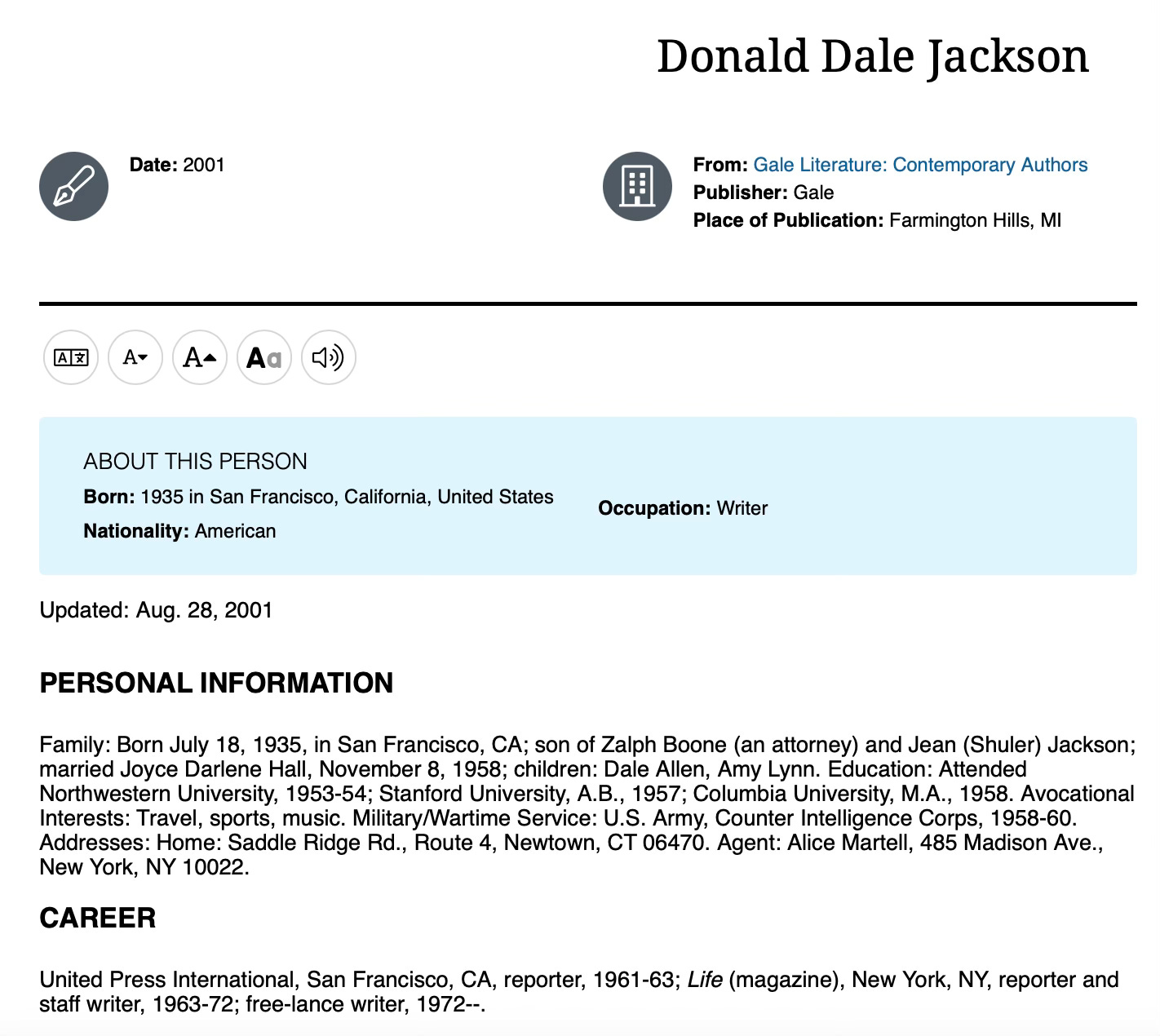
How did I know Donald Jackson was connected to CIC? I was researching Jackson’s biography and was tipped off to Jackson’s CIC connection when I came across a March 2017 comment left by Steven Uanna for an April 15, 2010 article at David Lifton’s Substack. Following Uanna’s example,7 I queried the Gale Literature Resource Center for details on Jackson’s life, as seen below. The Dale database described Jackson as working for the “U.S. Army, Counter Intelligence Corps” from 1958 to 1960.8
Before continuing, I should explain how it was I even came to investigate Jackson’s past and his credentials.
I recently researched the backgrounds of psychiatrists consulting with the Warren Commission regarding Lee Harvey Oswald’s ostensible motivations for supposedly shooting John Kennedy. It turned out, much to my own surprise, that three of the four psychiatrists contracted as consultants had connections with the CIA. One of them, Dr. Howard Rome, had even been a consultant for the CIA’s Artichoke and MKULTRA mind control programs. Another, Dr. Winfred Overholser, had headed the government’s top secret research study on “truth drugs” during World War II.
It seemed to me that the CIA’s sudden appearance in the corridors of the Warren Commission, in the discussions that would paint Oswald as a crazed assassin, was no accident. As others have pointed out, the footprints of the intelligence world are all over the JFK assassination story, from Oswald’s Dallas “handler,” CIA informant (if he wasn’t more than that) George de Mohrenschildt, to CIA Counterintelligence Chief James Jesus Angleton’s surveillance on Oswald’s “politics, his personal life, his foreign travels, [and] his contacts,” to Jack Ruby’s psychiatric entanglement with CIA MKULTRA doctor Louis Joylan West.
Perhaps because in my pre-retirement career I was a psychologist, I am drawn to the aspect of the JFK assassination mystery that concerns the supposed reconstruction of the Oswald’s life history. I am not alone in thinking this is an important aspect of the overall story surrounding the assassination, particularly in the formative months surrounding the activities of the Warren Commission.
As law professor Jonathan Simon wrote in 1998 for the Yale Journal of Law and the Humanities (Vol. 10: 75):
Oswald’s biography is the conceptual centerpiece of the Warren Report, the symbolic axis on which it turns. For the Warren Commission was charged not only with discovering the truth about the assassination, with discovering its meaning, but also with persuading the American people of that truth. The Commission had to do more than simply trace the bullets that killed President Kennedy to a gun in Lee Harvey Oswald’s hands: It had to fill the empty space of that trajectory with a believable explanation; it had to make sense of what happened. And as the Commission began to edge toward its celebrated thesis that Oswald alone was responsible for the death of the President, it became clear that its Report would have to anchor the truth of the crime inside Lee Harvey Oswald himself.9 [page 77, PDF pg. 3; link to download full article]
When looking at the construction of Oswald’s life and motivations, which unfolded over the first weeks and months after the assassination, a number of early articles stand out. While there were early newspaper stories about Oswald’s ostensible Marxist views, his time in the Soviet Union, and his supposed position as “Secretary” of the pro-Castro Fair Play for Cuba Committee, I am interested in how the psychiatric angle surrounding Oswald’s biography was exploited. The psychiatric narratives were meant to frame Oswald’s supposed motivation for the crime. It took about a week for the mental illness meme to surface.
“Potentially dangerous”?
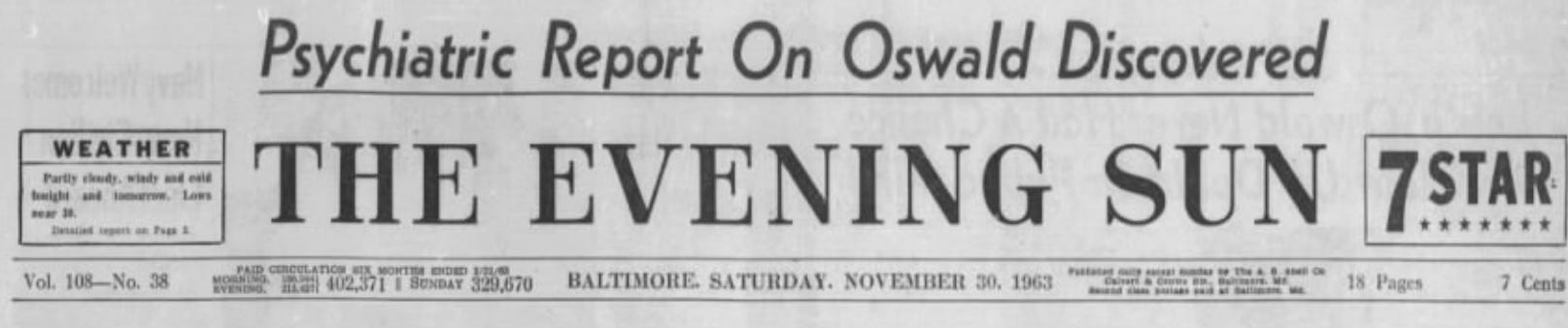
On November 30, 1963, the New York Post broke the story about Lee Oswald’s teenage psychiatric history. Apparently the New York Post article did not carry a byline. Frustratingly, I have not been able to find an online copy of the Post story, which was copyrighted and not widely spread beyond the Post itself. But an Associated Press article leaning on the Post’s reporting got wide coverage.
The Post article quoted then “presiding justice of the family court,” Florence M. Kelley, who confirmed there was such a psychiatric history and that the court had provided information about it to the FBI, something Kelley knew was ethically dicey because Oswald had been a juvenile. In April 1953, Oswald had been referred to Youth House in the Bronx for chronic Junior High truancy, and received the standard psychiatric and social worker evaluations for that time.
The Post’s real dirt came from anonymous sources. The paper reported:
“It was learned from other sources that the psychiatric report recommended young Oswald, then only 13, for commitment…. The recommendation was turned down by the court.
“The probation report found schizophrenic tendencies and said that Oswald was potentially dangerous.”
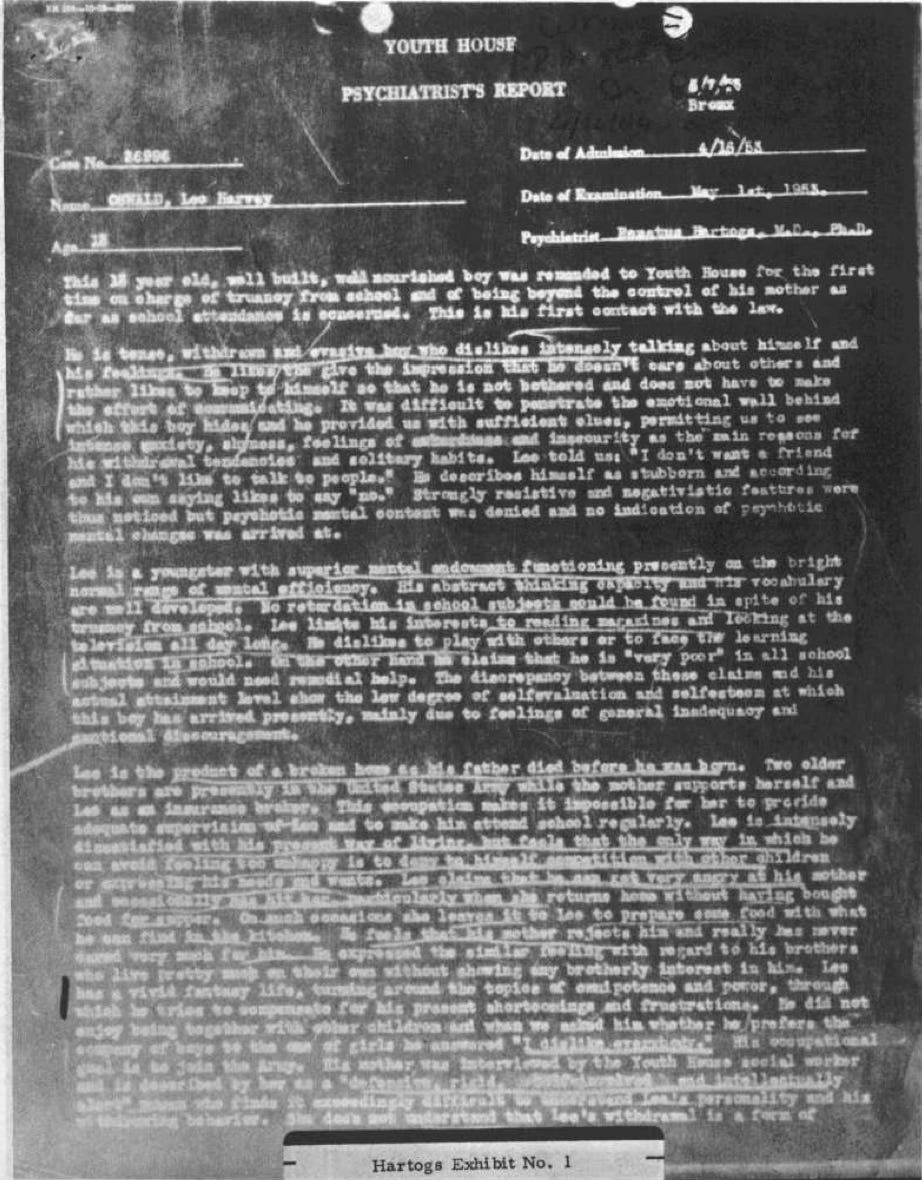
These were all lies. Below is a copy of the report by Oswald’s probation officer, John Carro. The only “dangerousness” was to Oswald, from the possibility that the young boy would remain isolated from “social contacts with other children his age,” according to Carro.
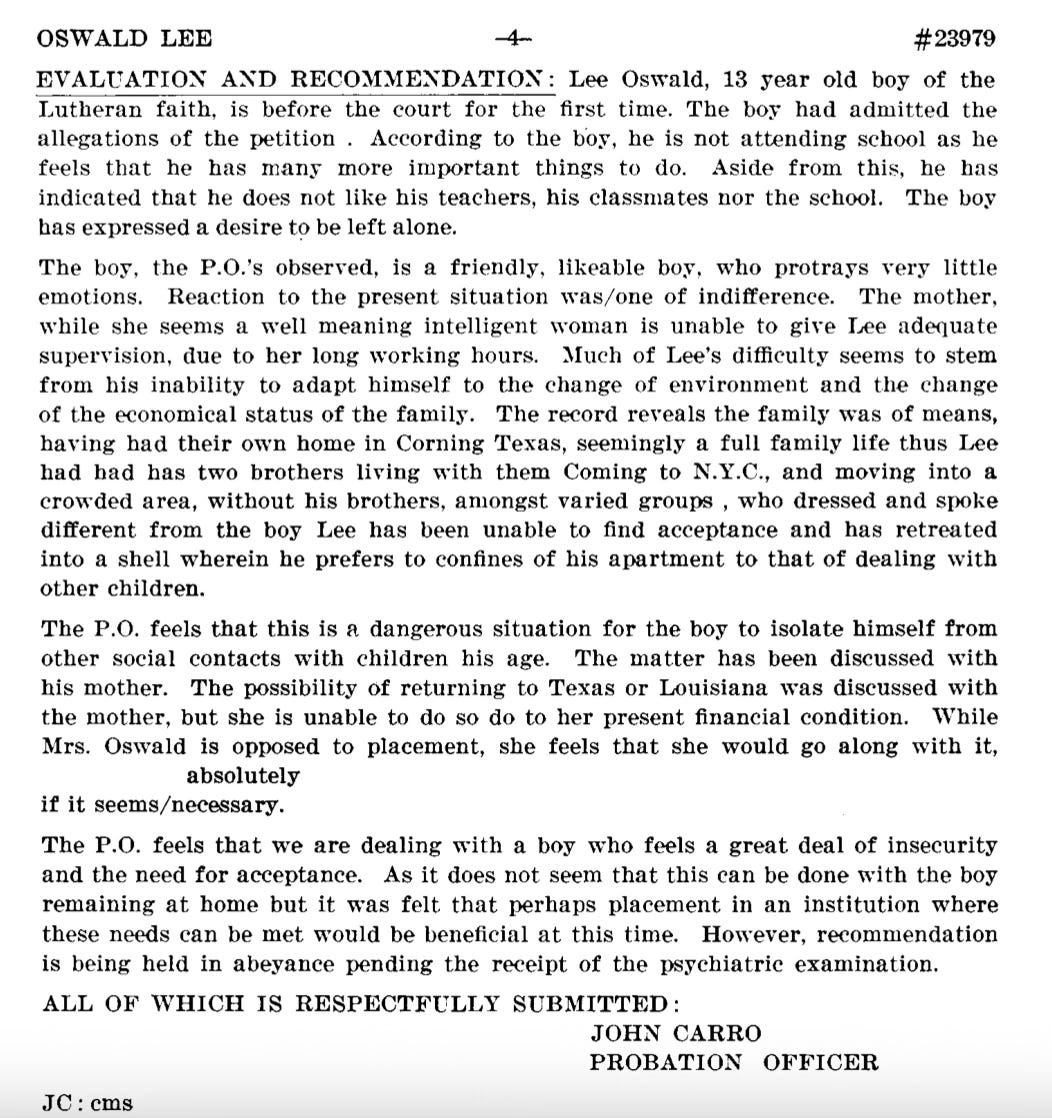
As one can readily see from Carro’s report, there had been some talk of institutionalizing young Lee, but a final decision awaited “the receipt of the psychiatric examination.” That assessment was the job of Dr. Renatus Hartogs, the head psychiatrist at Youth House. Hartogs, who had been a psychiatrist at Sing Sing prison before coming to Youth House, would play a crucial role in the formation of the Oswald legend, portraying the youngster — years later, and only after the assassination — as a volatile, dangerous, mentally deranged teenager. In fact, that is what Hartogs would tell newspaper reporters and the Warren Commission. But the documentary evidence doesn't back up that narrative. And, notably, the Warren Commission wasn’t buying it either.
The press continued to vilify Oswald, building to a major article in the December 8, 1963 New York Times, “Lee Harvey Oswald: The Man and the Mystery.” Written by Donald Janson, in a nod towards fairness the article referred to Lee as “the accused assassin,” but the neutrality ended there. It was, in fact, a hit piece. In addition, it relied on Hartogs’ retrospective report for scientific evidence:
… the life story of the secretive young malcontent has not been completely pieced together, but what is known casts some light on the troubled man and the mystery he created just before his death….
He was absent 47 days from Junior High School 117 from October, 1952, to January, 1953. John Carro became his probation officer. He found that the 13-year-old youngster was staying home and watching television in the Oswald's small furnished apartment much of the day. Neighbors reported that he played alone with toy guns.10 Mr. Carro found him a withdrawn and friendless child who was taunted at school because of his Southern drawl and because he wore blue jeans….
A fourth judge sent him to the Youth House for Boys in the Bronx. He was examined for a month there in 1953. The chief psychiatrist, Dr. Renatus Hartogs, found that the slim 13-year-old had schizophrenic tendencies and was "potentially dangerous." This examination, performed 10 years ago, found Oswald to be full of anger although outwardly calm. It found he had fantasies involving violence. The fatherless boy had a hatred of authority, fixed on a father symbol. His personality was unruffled, seclusive, aggressive.
Why was “potentially dangerous” in quotes, because there is no such quote in Hartogs’ report on Oswald? Was Janson quoting Hartogs directly? Whether or not Hartogs himself was the source for Janson’s article, below is a relevant portion of Hartogs’ testimony before the Warren Commission on April 16, 1964. Recalling that he remembered Oswald years later, after the assassination, because he had given an informal seminar on his case at Youth House, Hartogs said:
We gave a seminar on this boy in which we discussed him, because he came to us on a charge of truancy from school, and yet when I examined him, I found him to have definite traits of dangerousness. In other words, this child had a potential for explosive, aggressive, assaultive acting out which was rather unusual to find in a child who was sent to Youth House on such a mild charge as truancy from school. This is the reason why I remember this particular child, and that is the reason why we discussed him in the seminar. [pg. 217]
As I wrote elsewhere:
According to the WC report, “Contrary to reports that appeared after the assassination, [Hartog’s] psychiatric examination did not indicate that Lee Oswald was a potential assassin, potentially dangerous, that ‘his outlook on life had strongly paranoid overtones’ or that he should be institutionalized.” [See Chapter 7, pg. 379]
Contrary to the documentary record, Dr. Hartogs, who testified before the Warren Commission on April 16, 1964, told his examiners, “If I can recall correctly, I recommended that this youngster should be committed to an institution.” Hartogs did all he could to condemn Oswald to the authorities, once he realized that Oswald was the child he had evaluated eleven years earlier. He told the FBI that the young Oswald had “extremely cold, steely eyes… there was nothing emotional, affective about him.” Oswald’s “suspiciousness towards adults” showed he had a “severe personality disorder.”
When [Warren Commission Assistant Counsel, Wesley] Liebeler showed Hartogs a copy of his original psychiatric report, the report presented a very different picture of Oswald, one that recommended probation and not a “more harmful placement approach,” such as psychiatric commitment. Hartogs could not account for the difference between his report, which said nothing about dangerousness, and his memory. A somewhat blurred copy of Hartogs’ report is available here [and inserted above]; and here is a textual, cleaned-up version of the report. Nothing of Hartogs’ contradictory testimony to Warren Commission examiners ever made it into the [Warren] report. [italics for emphasis and bracketed material is added]
Amazingly, when Liebeler confronted Hartogs with his mischaracterizations about his report to the Warren Commission, Hartogs had little to say about it except to plea that he was relying on memory for events then some ten years in the past. But more amazing is the fact that even after his confrontation with Liebeler, Hartogs returned to his bogus summation of the Oswald report, with claims about Oswald’s “dangerousness,” “schizophrenia,” propensity to violence, etc., for years afterward.
Hartogs: From “Assassins” to “Betrayal”
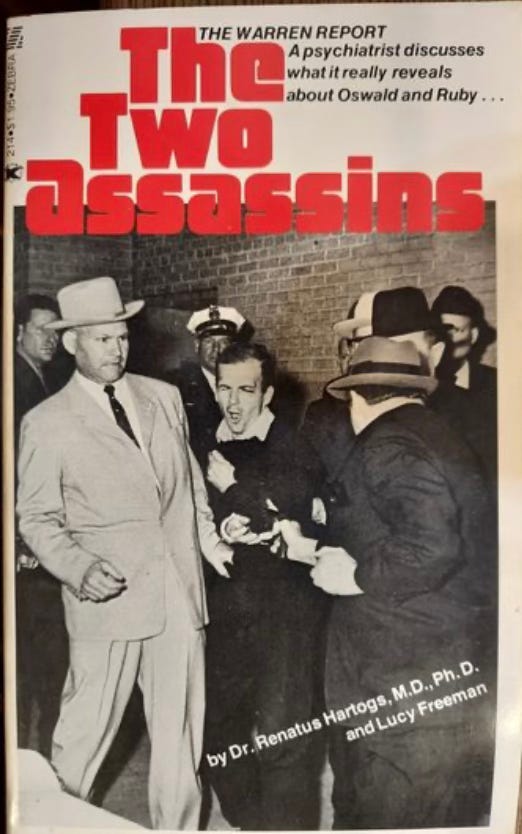
In 1965, Hartogs authored, along with journalist Lucy Freeman, the book The Two Assassins. I am working on obtaining a copy of Hartogs and Freedman’s book, but I was able to see via Google Books’ entry that the initial chapter is called, “The Twisted World of Lee Harvey Oswald.” Apparently, in the book Hartogs also provided his supposed psychiatric expertise on the “second assassin,” Jack Ruby, killer of Lee Oswald (although, as Paul Abbott has shown, there may even be questions about Ruby as the shooter).11
According to a book review of the Hartogs-Freeman text, the book still repeated the same old slanders and lies about the young Oswald. “This child is explosively dangerous and we can expect him to commit an act of violence during his lifetime if he does not get help in understanding his fury,” Hartogs claimed in the book, indicating this was something he wrote down after evaluating Oswald. Of course, nothing like that was in his 1953 report on young Lee, and has never surfaced in any other report.
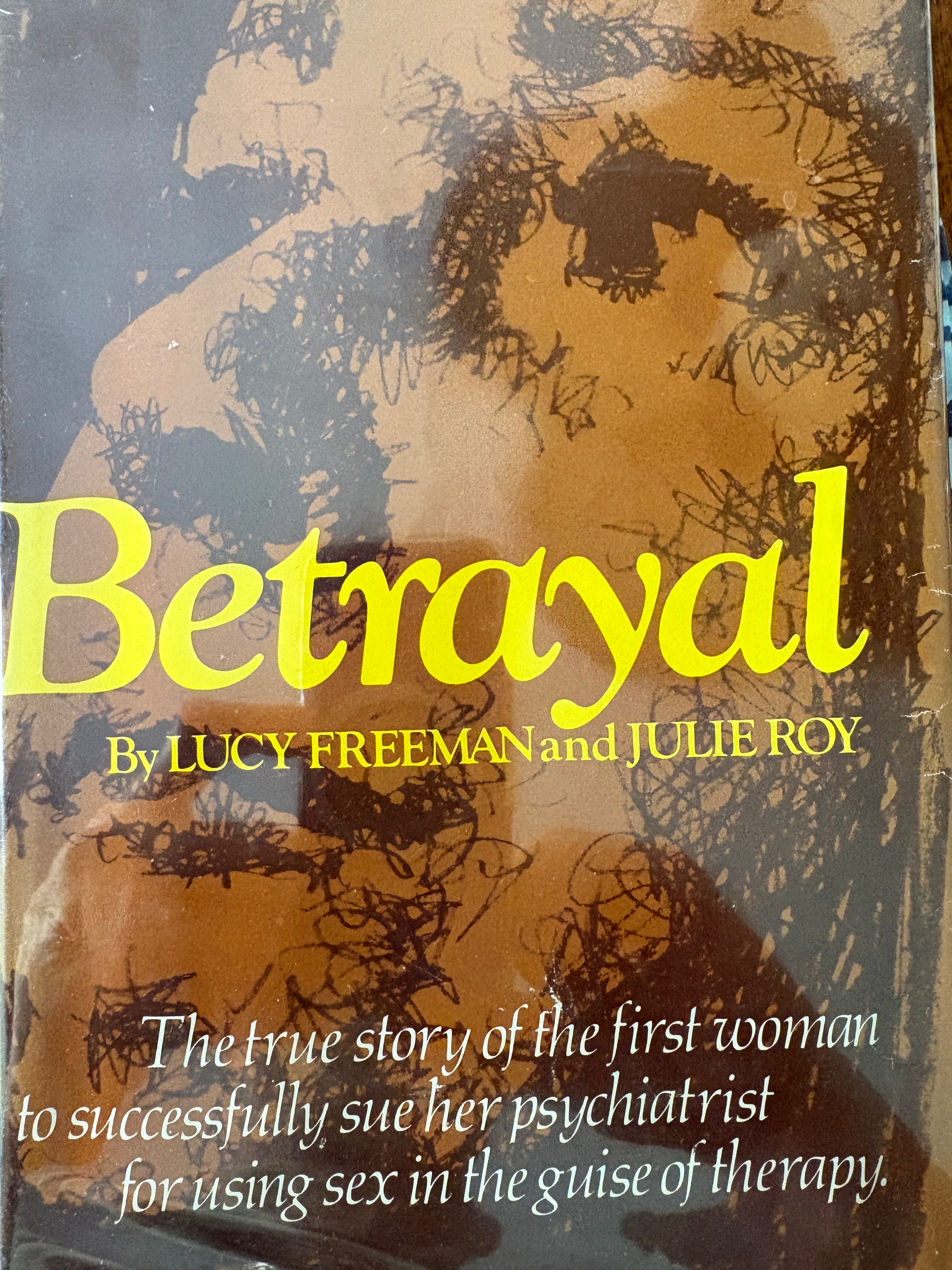
The press deserves a huge share of the blame for spreading Hartogs’ lies. The European-born Hartogs comes off as a self-promoter and highly unethical. It is with some irony that his career ended approximately ten years after the publication of The Two Assassins, when a jury found him guilty of coercing sex repeatedly with his patient Julie Roy, a secretary at Esquire Magazine. Ms. Roy later wrote a book about all this with Lucy Freeman — the same journalist who co-wrote Hartogs’ Assassins book! That book was titled Betrayal: The true story of the first woman to successfully sue her psychiatrist for using sex in the guise of therapy.
It’s a sordid tale I will leave the reader to pursue if they wish. In the end, a jury agreed that Hartogs was guilty of malpractice and awarded Roy “$250,000 in compensatory and $100,000 in punitive damages,” which was reduced later upon appeal. Hartogs, who was then 67 years old, gave up his license “to avoid state disciplinary procedures,” according to one newspaper account. I will only remark that, one, the verdict and Hartogs’ actions speak to his lack of professional ethics. Two, Lucy Freeman certainly seemed to get around! Perhaps the latter book was some kind of penance for her initial work with Hartogs.12
It is worth citing here for the record Hartogs’ original summary of his evaluation of the young teen Oswald, which was passed on to Oswald’s probation officer. I think given the pervasiveness of the lies about his report, which have circulated for decades now, the full text of that summary should not be passed over here. In addition, Hartogs’ original summary makes a nice preface for the discussion below on the distortions of the psychiatric record Donald Jackson will retail in his infamous Life Magazine article.
This 13 year old well built boy has superior mental resources and functions only slightly below his capacity level in spite of chronic truancy from school which brought him into Youth House. No finding of neurological impairment or psychotic mental changes could be made. Lee has to be diagnosed as "personality pattern disturbance with schizoid features and passive-aggressive tendencies." Lee has to be seen as an emotionally, quite disturbed youngster who suffers under the impact of really existing emotional isolation and deprivation, lack of affection, absence of family life and rejection by a selfinvolved and conflicted mother. Although Lee denies that he is in need of any other form of help other than "remedial" one, we gained the definite impression that Lee can be reached through contact with an understanding and very patient psychotherapist and if he could be drawn at the same time into group psychotherapy. We arrive therefore at the recommendation that he should be placed on probation under the condition that he seek help and guidance through contact with a child guidance clinic, where he should be treated preferably by a male psychiatrist who could substitute, to a certain degree at least, for the lack of a father figure. At the same time, his mother should be urged to seek psychotherapeutic guidance through contact with a family agency. If this plan does not work out favorably and Lee cannot cooperate in this treatment plan on an out-patient's basis, removal from the home and placement could be resorted to at a later date, but it is our definite impression that treatment on probation should be tried out before the stricter and therefore possibly more harmful placement approach is applied to the case of this boy. The Big Brother Movement could be undoubtedly of tremendous value in this case and Lee should be urged to join the organized group activities of his community, such as provided by the PAL or YMCA of his neighborhood.
As the above text shows, Hartogs found the 13-year-old Oswald to be intelligent, non-psychotic, lacking neurological impairment, with no personality “disorder.” The statement that one has “features” or “tendencies” of personality disturbance means — and I have written dozens of psychological evaluations for attorneys in my career, and testified on them as an expert witness in court — that some or a few symptoms were present consistent with certain “personality patterns” that had relevance in the case. In Lee’s case the symptoms were shyness and aloofness (“schizoid” traits), and a certain resistance to being treated by adults he did not trust (“passive-aggressive” to “professionals” like Hartogs).
Rather than someone to be committed to a psychiatric hospital or setting, Lee Oswald was at that time understood to be a child who “suffers under the impact of really existing emotional isolation and deprivation, lack of affection, absence of family life and rejection by a selfinvolved and conflicted mother.” The emphasis on blaming the mother is a common one in psychiatry and psychology and Dr. Hartogs and the people at Youth House had little seeming sympathy for a working-class mother struggling to make a living, bring up children after the death of a spouse, and still have some kind of satisfying life for herself. What Lee needed, Hartogs felt, was a consistent father figure, someone like a Big Brother or the leader of a YMCA group activity. He did not need institutionalization.
Rather than a young monster, Lee was a child who could “be reached through contact with an understanding and very patient psychotherapist.” In other words, he was relatable, and in fact, that is how some of Oswald’s teachers and social worker found him to be.
But that is not how Hartogs described Lee years later to the newspapers, nor how he apparently portrayed him in his book, The Two Assassins.
The Character Assassination of Lee Harvey Oswald
Returning to Jackson’s Life Magazine article, the former CIC man oversold Hartogs’ evaluation of the young adolescent Oswald as “[t]he most penetrating personality analysis ever made on Lee Oswald” (pg. 71). The Warren Commission’s quiet debunking of Hartogs’ assessment wouldn’t be published until their entire report was released to the public on September 27, 1964. Hence, Jackson may not have had access to other critiques of Hartogs’s work. But he didn’t have access to Hartogs’ report either. That didn't apparently stop Jackson, who wrote, “the substance of [Hartog’s report] is as follows” (in part):
It was apparent that Oswald was an emotionally disturbed, mentally constricted youngster who tended to isolate himself from contacts with others, was suspicious and defiant in his attitude toward authority, and overly sensitive and vengeful in his relationships with his peers…. [he] did not seem to have developed the courage to act upon his hostility in an aggressive or destructive fashion. He also appeared to be preoccupied about his sexual identity and his future role as a male.
He was guarded, secluded and suspicious in his dealings with the psychiatrist…. He could not become verbally productive and talk freely about himself and his feelings….
Dr. Hartogs concluded that here was definitely a child who had given up hope of making himself understood by anyone about his needs and expectations. In an environment where affection was withheld, he was unable to relate with anyone because he had not learned the techniques and skills which would have permitted it. A diagnosis of incipient schizophrenia was made, based on the boy’s detachment from the world and pathological changes in his value systems. His outlook on life had strongly paranoid overtones. The immediate and long-range consequence of these features, in addition to his inability to verbalize hostility, led to an additional diagnosis: “potential dangerousness.”
Dr. Hartogs’ report was sent to the Children’s Court with the recommendation that the child be committed to an institution for his own protection and that of the community at large. He felt that the treatment might have led to improvement, and that ultimately the boy would have been rehabilitated. His recommendation was not followed. [Jackson, “The Evolution of an Assassin,” February 21, 1964, Life Magazine, pg. 72]
“Emotionally disturbed, mentally constricted… suspicious and defiant… overly sensitive and vengeful… hostility… preoccupied about his sexual identity… guarded, secluded and suspicious… unable to relate with anyone… incipient schizophrenia… detachment from the world and pathological changes in his value systems… strongly paranoid… ‘potential dangerousness’”!
It is difficult to believe so many negative connotations about a youngster is even possible, especially one whose only great crimes thus far in his life had been truancy and a reluctance to open up freely to state psychiatry and child custody officials, a child they knew had been recently teased and likely bullied in school. But it’s important to remember this was not the characterization of Oswald’s psychiatrist back in 1953. This was Hartogs’ portrayal of Oswald to Donald Jackson of Life Magazine.
Hartogs further told Jackson “he was not surprised when Lee Oswald was arrested for the assassination of President Kennedy. ‘Psychologically,’ [Hartogs] said he had all the qualifications of being a potential assassin…. A person like Oswald resents a lifetime of being pushed to the sidelines. He culminates his career of injustice-collecting by committing a supreme, catastrophic act of violence and power” (pg. 72)
A cursory perusal of the graphic subheads throughout the Life article shows the narrative working on a meta-formatting level. Oswald’s “evolution” into an assassin is revealed here in capsule. From the able young boy to the alienated and “lost” adolescent, to the hermit-like Marine, to the abusive and insensitive husband, to someone who was losing control and seeking violent actions, until he “poked a rifle out that window” on the sixth floor of the Texas School Book Depository.
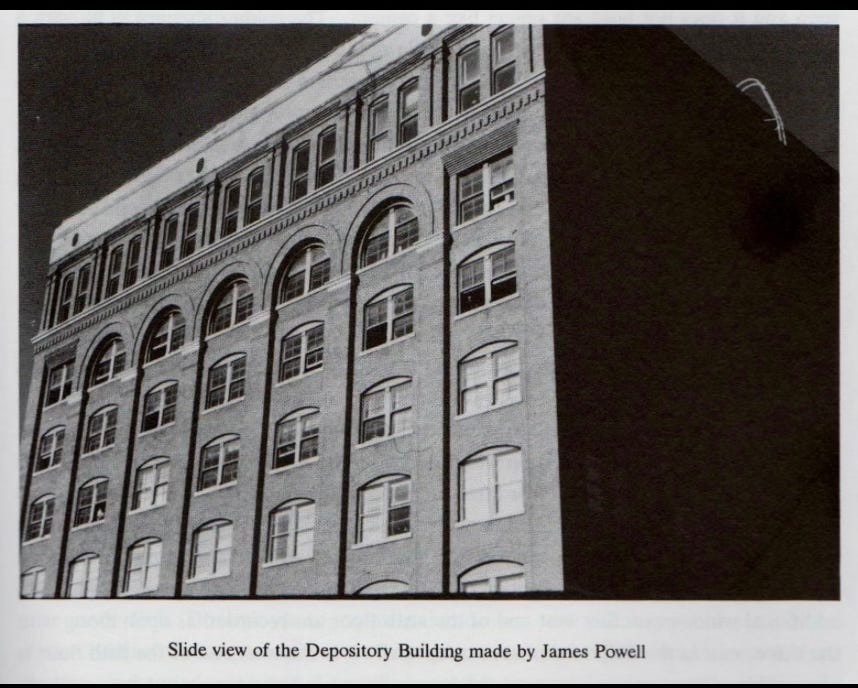
And who was there to snap a photo of the building and the sixth floor window within five minutes of the assassination? Sergeant James W. Powell of the 112th Intelligence Corps Group.


Army Intelligence in Dallas on November 22, 1963
On April 12, 1996, James Powell was interviewed for the Assassination Records Review Board by Timothy Wray. The following February, Wray would write a memorandum on the subject of “Army Intelligence in Dallas” for the AARB. In the latter report, Wray recalled the previous testimony of Colonel Robert E. Jones, who identified himself as the Operations Officer for the 112 Military Intelligence Group at the time of the JFK assassination. Col. Jones insisted before the House Select Committee on Assassinations (which operated from September 1976 to December 1978) that the 112th INTC Group “had been involved in presidential security activities on November 22, 1963, and that it had had ‘between eight and twelve’ plainclothes agents in Dealey Plaza….” (pgs. 5-6).
Wray found this to be “a remarkable assertion in light of the fact that no such military presence had previously been noted by the Secret Service, the FBI or the Warren Commission” (Ibid.). On that same note, Wray’s report critically assessed statements made by Colonel (USAF, Ret.) L. Fletcher Prouty, who claimed the 112th INTC and its subordinate units were trained in presidential protection, but were ordered to “stand down” on the day of the assassination.
Wray interviewed Prouty, who does not come off very well in Wray’s ARRB Army-Dallas intelligence narrative, and interested readers should see the discussion in both Wray’s essay (pgs. 9-13) and the Prouty interview, both linked above. For a comprehensive critique of Wray and the ARRB’s criticism of Prouty, see James DiEugenio’s June 2022 essay, “Fletcher Prouty vs. the ARRB,” at the Kennedys and King website.
One thing Wray briefly mentioned was the 112th’s record of participation in domestic surveillance of civil rights activists and those deemed political radicals. Edward Coyle, of the 112th INTC, told Wray that such surveillance was “standard operational procedure for every military unit in the area” (pg. 19). Coyle downplayed any active investigation of such groups or individuals, and Wray, in his Dallas report seemed to accept that. Today, we are stymied from further investigation on that point because the Pentagon destroyed all the relevant records in 1971.
Wray wrote that his investigation had revealed Jones’s testimony to have “many patent inaccuracies and misrepresentations, beginning with what his job in the 112th actually was.” According to Wray, Col. Jones was not the operations officer (S3) for the intelligence group; he was its intelligence officer (S2), a position Wray felt was much less involved in the day-to-day running of the unit than an operations officer, who "would be much more knowledgeable of the 112th’s day-to-day activities than the S2” (pg. 6).13
But why would Jones lie? Wray really couldn’t say. Wray felt fairly certain that there had been no official presence of military intelligence officers in Dealey Plaza the day of the assassination, or any other time in proximity to it. “The 112th’s unit history for 1962-3 says nothing about it providing security for the President in Dallas or anywhere else,” he wrote (pg. 7).
Interestingly, however, Edward Coyle, the warrant officer for the 112th INTC, told Wray that the 112th’s Dallas Regional Office commander, Lieutenant Colonel Roy Pate, “attended monthly meetings with the heads of the various local law enforcement and military intelligence agencies within the Dallas community, and that upon his return from such meetings [he] would commonly assemble the office’s personnel to pass on to them any important information he had picked up” (pg. 8).
When Pate came back from the monthly meeting prior to the assassination, he expressed “some surprise” that “the Secret Service and the Dallas Police Department said that they had everything under control and needed no additional help from other agencies” (pg. 8). If the 112th or the other local military intelligence group, the 316th Intelligence Group, did not have experience protecting the president or assisting the Secret Service, then why was the 112th’s commander surprised when the SS or the Dallas police did not ask for help for the forthcoming Kennedy visit?14
Wray felt the assertion of a military presence at Dealey Plaza was not the only problematic statement made by Colonel Jones. According to Wray, Jones also misstated what James Powell’s rank was.
According to Wray, “Jones asserted that James W. Powell was an officer (a captain) on duty in Dealey Plaza at the time of the assassination. Powell was actually a Sergeant (E-5), a fact confirmed both by Powell himself and by our examination of Powell’s VA and military records. According to Powell, he was not on duty at the time of the assassination, but rather had asked for the day off in order to see the presidential visit” (pg. 7). Hence it was as a kind of presidential motorcade sightseer that Powell found himself only a hundred yards or so away from where the shots were fired that felled JFK, or at least that was the story Powell told, and that Wray seemed to believe.
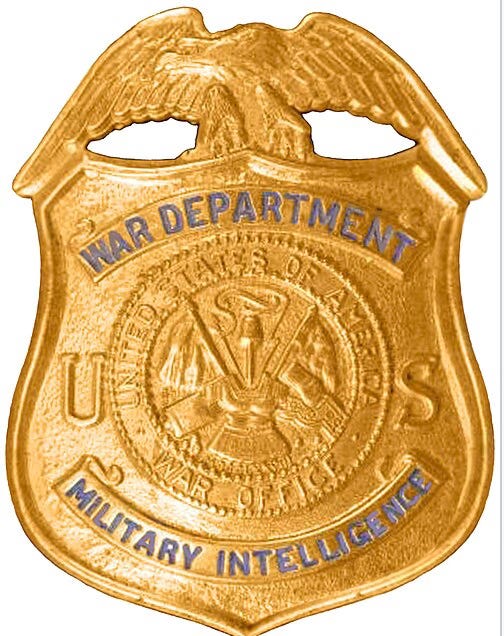
But what did Powell actually say? In his April 1996 interview with Wray, Powell explained that his primary duties for the 112th INTC consisted of investigations for security clearances for militarily sensitive jobs. In addition, he had special training in “investigative photography.” He explained that this consisted of covert photography during surveillance.
Wray moved on to the core issue of the interview:
WRAY: Do you recall any discussion with other members of the 112th in anticipation of the presidential visit? Other people that were going to try to get time off to go see it, or anything else that anybody was going to be doing in connection with that? With the visit?
POWELL: To be very honest with you, no. That’s surprising when I think about it. I know others were there, they were on duty, or they were working the normal things that they do and did not ask for time off to do this.
WRAY: Do you recall any discussion, or activities the 112th was going to do related to providing security for the President.
POWELL: No. Not at all....
WRAY: Okay, now you mentioned that on the 22d of November that you had asked for time off. I understand. I’m just clarifying something here. Some members of the unit were still — maybe most members of the unit — were working that day. Is that correct? But you had specifically asked for time off?
POWELL: Right. Because if you’re... In my capacity I’m expected to be out — I have leads that are given to me. When I’m given a lead, I’m expected to go out and interview references and look for records and that type of thing during the course of the day, and then file a report on each one of those. That’s what the other agents were doing except for those that, there was always a staff in the building — in this case the Rio Grande Building — and there were probably three or four of those people there at that time when I had my time off. The other agents were just out doing their regular job. (pgs. 4-5, italics added for emphasis)
Powell certainly seemed to say at one point that there were other military intelligence agents from his unit in Dealey Plaza that day. Sure enough, as I shall show, more MI agents will show up in Dealey. Wray asked Powell again about the presence of military intelligence agents in Dealey Plaza. But in setting up Powell’s reply, it’s important to note that Powell explained first that hearing the assassin’s (assassins’?) shots he wandered over to the Texas School Book Depository and the train tracks that ran nearby. Sometime in the first minutes after the shooting, Powell took a photograph of the TSBD, which showed the sixth floor window from which the shots supposedly originated.
Powell then went inside the TSBD to call the 112th INTC office to “tell them what happened” (pg. 9). He subsequently went back outside and began to interview witnesses. As he was interviewing one man, a “fairly high-ranking policeman… like a chief, or whatever” got out of his car and “literally took the guy away” from Powell, despite the latter flashing his credentials.
Prior to that, Powell told Wray he had accompanied a group of police officers and sheriff’s deputies to investigate the parking lot and railroad yard next to the Texas School Book Depository. Powell said he showed his military intelligence credentials to the officers and they accepted his presence. Eyewitnesses told Powell and the others they had “heard someone running through that area” (pg. 7).
Powell’s presence in Dealey Plaza and his claims to have assisted, at least somewhat, in the investigation, is consistent with what Colonel Jones told HSCA investigators back in the 1970s:
In recalling where the military agents might have been during the motorcade itself he thought they would have been in a number of different places.
“Some... may have accompanied the motorcade and some of them may have stayed in Dealey Dealey [sic] Plaza. Some may have been with the Secret Service and the FBI.” [See page 6; ellipses is in original]
A Branch Office of U.S. Army Intelligence Inside the Dallas PD
For some reason, Powell decided to reenter the TSBD, and encountered a hectic scene, with police “detaining everybody who was in the building at that point” (pg. 9). Powell told Wray the police did not believe he was who he said he was, or at least they would not let him leave the building. Powell said he never went above the second floor of the building, and remained trapped inside for some 45 minutes, until he was rescued by a superior officer. He was adamant that he never assisted the police in any way.
WRAY: Now Wilson Pate from your unit came...
POWELL: Page.
WRAY: Page, I’m sorry, got you released. Did you, where did you go then? Did you go home, or did you go back to your office?
POWELL: I’m pretty sure I went back to the office....
WRAY: Do you recall during the time that you were in Dealey Plaza, except for Wilson Page, did you see anyone, do you recall seeing anyone else from the 112th?
POWELL: No. [pg. 10]
According to Wray’s later report on “Army Intelligence in Dallas”, Powell was wrong about how he finally got out of the TSBD. Powell recalled that Master Sergeant Wilson Page had rescued him. But both Edward Coyle, the warrant officer for the 112th, and another fellow military intelligence officer, Coyle’s immediate superior, Lieutenant Stephen Weiss, told Wray they were the ones who got Powell out of his predicament at the TSBD, with “the assistance of Jack Revill, a police official they knew from their liaison activities, who was the head of the Dallas Police intelligence section and who was at the scene outside the TSBD” (pgs. 13-14. (Pate, who Wray himself momentarily misidentified, was Lt. Col. Roy Pate, the commander of the 112th.)
Coyle came to rescue Powell at the TBSD, having only a short time before left a meeting with FBI agent James Hosty and Alcohol, Tobacco, and Firearms agent Jack Ellsworth at the latter’s office “just before the assassination” (pg. 14). Hosty has a controversial history in relation to Oswald, having interviewed Lee’s wife, Marina, and been the recipient of an allegedly threatening letter from Oswald, which Hosty destroyed two days after the assassination, supposedly on orders from his superiors. Hosty’s address and contact information were also found in Oswald’s address book.
It was part of Coyle’s job to meet representatives from other agencies. He must have made relationships with some of these other agency personnel. In his essay on “Military Intelligence in Dallas,” Tim Wray described the relationship between Coyle and FBI agent Hosty as “close” (pg. 5); Coyle referred to Hosty as “Jimmy.”
Coyle worked in 112th’s “Security Section.” Besides meeting with other law enforcement and government agencies, Coyle’s section conducted “Special Investigations,” as well. Wray asked Coyle, in an interview on October 26, 1996, “What would be an example of a special investigation?” (pg. 3).
Coyle responded:
Special investigation? We had, we were on very close terms with the Dallas Police Department, particularly their intelligence section. Now their intelligence section was run by an Army reserve colonel. I don’t remember his name right now. But all of the men assigned to his organization were in Army intelligence. [pg. 3]
From this one can construe that the Intelligence section of the Dallas Police Force in 1963 was essentially a branch office of U.S. Army intelligence. Some men on the force also belonged to a dubious project known as the 488th Army Intelligence Detachment, a private spy unit created by former Office of Strategic Services officer, Jack Alston Crichton.


According to an incredible list of missing assassination records compiled by assassination researcher William Kelley, “Records of the Dallas-based 488th Military (Strategic) Intelligence Detachment (Counter-Intelligence) unit histories and rosters 1962-1963” are among the many missing records. This, of course, makes research on the 488th difficult. For more on the 488th, see this discussion at The Education Forum (particularly Chuck Schwartz’s contribution), and Russ Baker’s investigation into Jack Crichton at WhoWhatWhy.
According to a memorial for Captain William Paul “Pat” Gannaway, chief of the Dallas PD’s Special Services Bureau in 1963, Gannaway was a member of the 488th. The article there also claims that approximately “half of the 488th's ~100 members were also DPD CIS detectives.” The CIS was the Criminal Intelligence Section of the Dallas PD’s Special Services Bureau. Captain Gannaway was also “one of the lead Detectives during the investigation of the assassination of President Kennedy…. he, along with 2 other CIS & 488th members, Dep. Chief George L. Lumpkin and Det. L.D. Stringfellow pointed to Oswald as the assassin very early on.”
According to the Spartacus Educational website, member of the 488th Military Intelligence Detachment, Dallas Deputy Police Chief George L. Lumpkin, “drove the pilot car of Kennedy's motorcade. Also in the car was Lieutenant Colonel George Whitmeyer, commander of all Army Reserve units in East Texas.”
While the 488th cannot be seen as strictly military intelligence, as it was a private and not a government enterprise, it would seem there was a great deal of interpenetration between official military intelligence, private “military intelligence” officers, and the Dallas police, if not also the FBI and CIA.
Returning to Coyle’s account of what he did after leaving his meeting with Hosty and Ellsworth, he told Tim Wray he hung around the corner of Main and Rio Grande streets and witnessed the presidential motorcade drive by. He was so close by, Coyle told Wray, “if I had stuck my hand out, just stretched my arm out, I would have hit President Kennedy right in the head” (pg. 6). Then he walked a half block to the Dallas 112th office, where he and Stephen Weiss heard the news that Kennedy had been shot.
The 112th office then received a call from Powell at the TSBD, some five blocks away. According to Coyle, Powell asked for them to come down to the Depository to identify him, and to bring him a camera. Except Powell told Wray that he already had his camera with him. “I had my camera and so forth” (pg. 8). In fact, he explained to the ARRB interviewer that he had taken the day off to go see the President arrive and take pictures.
WRAY: So you went to Love Field. Were you there for when the President initially arrived?
POWELL: Yes. Yes.
WRAY: And did you take pictures at that time?
POWELL: Yes I did. [Interview with James W. Powell, April 12, 1996, pg. 5]
So why did Warrant Officer Edward Coyle tell Tim Wray that Powell asked him to bring him a camera to the Texas School Book Depository? The simplest answer is that these actors didn’t have their stories straight, or perhaps Coyle misremembered. At least one member of the 112th, Stephen Weiss, who Coyle said went with him to the TSBD, must have decided that the best thing to do was remain silent and not speak to the ARRB. I will elaborate more on that a bit further on.

According to Wray’s essay, “Army Intelligence in Dallas,” it was Coyle who called for the meeting on the morning of November 22 with Hosty and ATF’s Ellsworth. Wray spent approximately a full page describing the hazy story behind the meeting — there had been a blown operation and Coyle wanted to prevent inter-agency screw-ups going forward — but one is left with the impression that it was certainly strange that at the moment of the assassination a military intelligence official was meeting with the FBI agent most associated with Lee Harvey Oswald.
Summing up the story the AARB’s questioning of military intelligence officials has left us with: Col. Jones allegedly lied about who he was and who was in Dealey Plaza on November 22, 1963. Sgt. Powell couldn’t accurately recall who rescued him from the building that was the site of the accused assassin’s lair. Powell remembered that there were other members of the 112th in Dealey Plaza on November 22, “on duty.” But then recanted that and said nobody was there but him. Powell claimed he didn’t involve himself in the investigation into the assassination that afternoon, yet he did interview at least one witness.15 At least four members of the 112th INTC were in Dealey Plaza shortly after the assassination: James Powell, Edward Coyle, Stephen Weiss, and (allegedly) Wilson Page. Shortly after the assassination, in early 1964, both Coyle and Weiss were transferred to Korea, a transfer that Coyle, in retrospect, thought “a little funny” (pg. 16). Much about the story surrounding military intelligence operations in Dallas in and around the assassination doesn’t hold together!
There is an interesting postscript to the mystery about whether the 112th and other military intelligence units in Dallas on the day of the assassination were there to protect the president or not. When Lieutenant Stephen Weiss was approached by ARRB investigators in February 1997, he indicated in a phone call in early March with Doug Horne (Tim Wray’s successor as Chief Analyst for Military Records for the ARRB) that he would not participate in any questioning about the assassination. See this March 12, 1997 email from Tim Wray to various ARRB staff.
ARRB General Counsel T. Jeremy Gunn wrote to Weiss and tried to reassure him, but to no avail. There was no further questioning of Weiss. A March 17, 1997 memo from Tim Wray to Doug Horne listed the many questions they hoped to ask Weiss. Among the various questions, it looks like Wray harbored some suspicions about Coyle’s transfer to Korea (pg. 2). Many years later, it looks as if military authorities wanted to put both Coyle and Weiss far away from potential assassination investigators.
According to a 2022 article by Jim DiEugenio, before he went silent, Weiss had told ARRB investigator Dave Montague that “Colonel Robert Jones had requested [the 112th] get in contact with the Secret Service and offer them supplementary protection for President Kennedy in Dallas. Weiss was surprised that the Secret Service declined. He said the word was that a man, whose name phonetically sounded like [Forrest] Sorrels, declined the offer.” If true, and if the military intelligence units were not then typically involved in presidential protection operations, then why would Jones have offered services in this particular instance on the otherwise non-infamous date of November 22, 1963?
But Weiss stopped talking.
“Everybody” in Intelligence Knew Oswald and Ruby

I can’t make up my mind about the contributions of ARRB Army Colonel Timothy A. Wray. Sometimes he seems keenly diligent. Other times he seems to have missed some key opportunities to follow up an important line of questioning, betraying a possibly a pro-military bias. Wray was an Army officer, and he had standing within the service as one of its intellectuals.
According to his C.V., Wray was a former Fellow at Harvard’s Center for International Affairs. From 1990-1993, he had been Special Assistant to the Vice Chairman, Joint Chiefs of Staff. In 1986, he wrote Standing Fast: German Defensive Doctrine on the Russian Front During World War II, a monograph for the U.S. Army Command and General Staff College Fort Leavenworth, Kansas. It was later published also as a book.
Consider Wray’s curious failure to follow up an important lead during his July 24, 1996 interview with Colonel Rudolph M. Reich. Retired now, in November 1963 Col. Reich was the commander of the 316th INTC Detachment, attached to the 112th INTC, and operating in and around the Dallas area. Prior to that assignment, Reich had been the S3, or Operations Officer, for the 112th Intelligence Corps Group.
Reich was a very knowledgeable guy, very connected. When he told Wray that he’d never ever seen a Secret Service agent before, except once “by accident” in Orlando, Florida, why then, Wray seemed predisposed to believe him (pg. 3). Reich was a prickly interviewee. He took offense to the idea that any information about military intelligence being involved in security the day JFK was shot could have come from himself or from any officer in the 112th/316th detachments.
Lambasting attorney and assassination researcher Mark Lane, Reich told Wray that Lane “had the information [about security assignments] from one of the privates, because the way the whole thing sounded, that we knew Oswald” (pg. 3). The transcript doesn’t make a lot of sense here. But I think it is probably accurate. Reich was flustered, upset, whether because of the memory of feeling attacked by or falsely blamed by Lane, or maybe from what he felt Wray might think, or something else. It seemed the train of questioning at that point had touched a nerve. For whatever reason, Reich felt he had to tell Wray how things actually were:
Everybody in the intelligence field in this area knew Oswald. And everybody knew Ruby. [pg. 3, bold italics added for emphasis]
You’d think Wray would have immediately jumped on such a startling assertion. But he let it lie awhile. Later he brought it up again.
WRAY: Okay. You mentioned a little bit earlier that people there were familiar with Oswald and they were familiar with Ruby. What was the basis for that knowledge, do you recall?
REICH: Just — I forgot which section... was it CI [counter-intelligence]? One of our sections... you know, they studied the newspaper, they cut out things, and hometown people, if they have [a] rowdy or something like that, they make photographs and just started a dossier on some of these people, you know what I mean?
WRAY: Yes, sir. [pg. 8, ellipses in original, bracketed material added]
Reich’s assertion that “everybody in the intelligence field” knew Oswald and Ruby from newspaper clippings or some dossier started on some “rowdy” is incredibly weak. Weaker still is how Wray snaps to attention when Reich seems to so obviously dissimulate. In any case, Wray let the subject drop at that point.16
Cody in Dealey Plaza
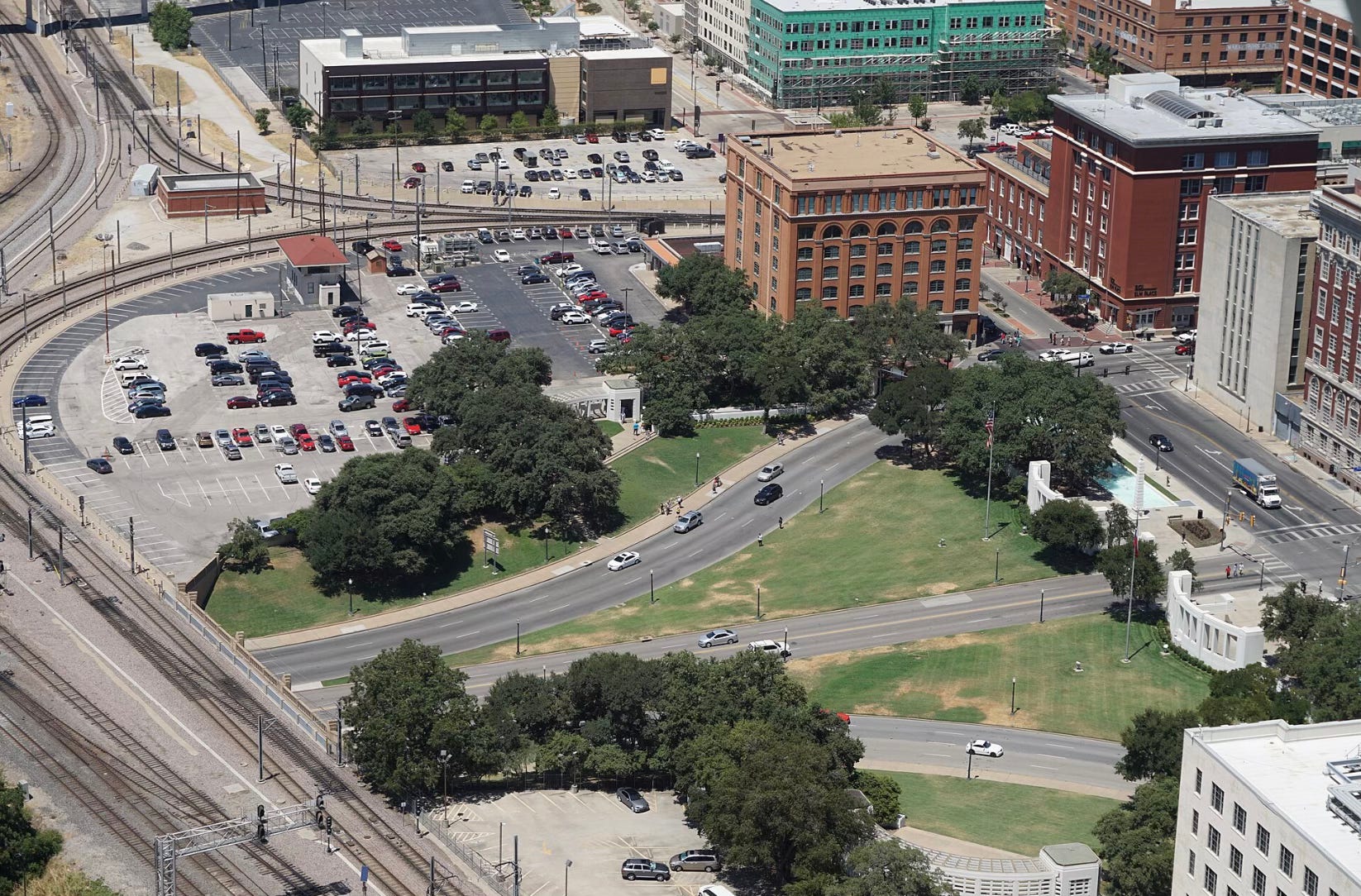
There was one more military intelligence-linked figure outside the TSBD shortly after the assassination that fateful afternoon — Jack Ruby’s old friend, CIC vet, Dallas policeman and gun expert, Joseph Cody.
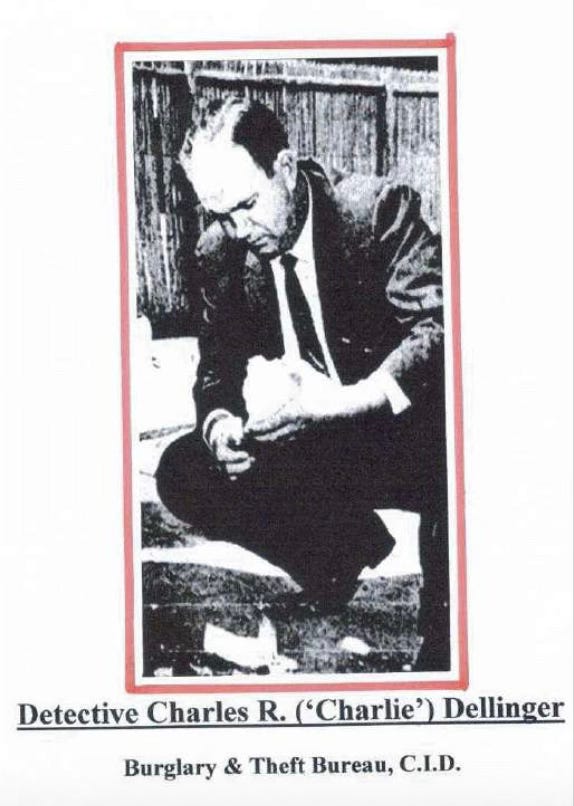
According to Cody’s 1999 interview for the Oral History Collection at The Sixth Floor Museum at Dealey Plaza, he, his partner, and the Chief of the Dallas PD Criminal Investigation Division arrived at the TSBD building “five to ten minutes” after the shooting. While his partner, Charley Dellinger,17 entered the building, Cody strolled over to the area in the street where the murder had taken place. He claims that he saw “a piece of Kennedy’s head bone lying by the curb” (17:50) When he saw “reddish hair” on the bone, he said he knew it was the president’s. Cody said he turned the skull evidence in.
As for Dellinger, Cody claimed that his partner was the first to discover the assassin’s rifle on the sixth floor. In this Sixth Floor Museum interview, Cody said, “My partner went upstairs and found the rifle. Now, he didn’t touch the rifle. He just stayed there and screamed for Lieutenant [J.C.] Carl Day, our crime scene man.”
Let’s make sure we understand that. According to Cody’s version of events, the man who discovered Oswald’s putative murder weapon was the police partner of Jack Ruby’s old friend, an ex-Counter-Intelligence Corps agent, who happened to buy Ruby the murder weapon he would later use on Oswald. Small world.
But it turns out there are a number of claimants for the person who found the 6th floor rifle, or who were at least present when it was discovered. Dellinger was only one of these, and he actually never went on the record saying he had discovered the rifle. That ostensible fact rests solely on the claims of Detective Cody. Altogether, there are some five to six candidates as to who found the rifle. The Warren Report and its supporting volumes themselves provide contradictory accounts. The various claims were collected and examined in a July 2008 article by Ian Griggs, “Who REALLY found the rifle?” in Dealey Plaza Echo, Vol. 12, issue 2, pgs. 1-20.
Cody also said that Oswald had almost been arrested when found on the second floor, mainly because he had been, allegedly, at that time the only person in the building above the first floor. But George L. "Lonnie" Lumpkin, Deputy Chief for the Dallas Police Department, let Oswald go “because Oswald worked there…. I would not have let him go,” Cody said.
One thing Cody didn’t mention (or wasn’t asked about). He didn’t say anything about James Powell’s presence, the intelligence agent from the 112th being kept inside the building by the police. Nor did he mention that other MI officers showed up at the Book Depository. Not that he should have mentioned these things, but I felt it was worth noting.
Cody’s interview is really quite remarkable and deserves a fuller examination, which I hope to do in the near future. As noted earlier in this article, Cody had also said that he had first interviewed Lee Oswald alone in his office. In fact, Cody declared that he had sat with Oswald for 10 or 15 minutes before he notified homicide detectives that he had Oswald in custody (26:55). (Cody indicated that he informed Homicide division that he had Oswald after the latter told him he worked at the Texas School Book Depository. Cody said he realized that this was the guy the homicide detectives were looking for. It’s an explanation I just don’t personally buy.)
This means that at key moments in the Oswald story — his October 31, 1959 interview with the U.S. consul in Moscow, Richard Snyder, and Oswald’s first interrogation by Joe Cody after his arrest in Dallas — Oswald was alone with military intelligence and/or CIA figures who could have given him instructions, or received a debriefing from them. There is no evidence that ever happened, of course. But all the linkages must be kept in mind, should more evidence arise in coming months or years.
See, for example, Larry Hancock, “Mysteries of the 112 Intelligence Corp Group,” JFK Lancer, Kennedy Assassination Chronicles, Vol. 7, Issue 4, 2019; Chad Nagle, “Trail of Destruction, Pt. 6: Oswald’s Army Intelligence Dossier,” JFK Facts, April 10, 2024; Rex Bradford, “Lasting Questions about the Murder of President Kennedy,” November 2001, History-Matters website; Peter Dale Scott, Chapter 17, “Army Intelligence and the Dallas Police,” in Deep Politics and the Death of JFK, University of California Press, 1993. Other authors and relevant articles are mentioned and linked in the main text of this article, though I am not suggesting that this article has definitively explored every possible source or text.
Some of the stories of the intelligence figures in this article touch upon other subject matters of interest to me. For instance, Lawson told the Warren Commission (pg. 318): “In 1953, March, I went in the Army and I had been a reservist and was called up as a CIC agent. I had 16 weeks of basic infantry, basic training, went to the CIC Counterintelligence School in Holabird, Md — Fort Holabird, Md. — outside of Baltimore, and then was assigned eventually to the Lexington field office where I did general counterintelligence work for the Army, background investigations, and some interviews of the prisoners, POW’s from the Korean war.” In other articles I have covered the use of CIA Artichoke mind control techniques on a small subset of returning “political,” i.e., leftist, Korean War POWs. Repatriated POWs who had confessed to participation in biological warfare by the US military also received special interrogations and threats. See “CIA, MKULTRA, and the Cover-up of U.S. Germ Warfare in the Korean War.”
Snyder was another figure whose biographical details were of interest to me. In his testimony to the Warren Commission, Snyder said that even before he entered the State Department’s Foreign Service, he “served for a brief time in HICOG in Frankfurt, Germany.” The HICOG, or the High Commission for Occupied Germany, was the prime Allied power in western Germany after World War II. Its first High Commissioner was John J. McCloy, who later served on the Warren Commission.
But it was another statement by Snyder to the Commission that caught my attention.
Mr. Snyder. My second post, I spent 1 year in the boondocks of Japan, in Niigata, on the Sea of Japan, in a one-man cultural center.
Mr. [Allen] Dulles. As a Foreign Service officer?
Mr. Snyder. As a Foreign Service officer; yes, sir. I was assigned to this duty at a time when USIS [U.S. Information Service] was still a part of the State Department, and when I reached my post it had already been separated, so I was on loan to them. And then a year and a half in Tokyo. Then a summer and an academic year at Harvard, in Russian area studies. [pgs. 261-262]
My most recent article, “The Secret Niigata Archive of Unit 731’s Biowarfare Research,” showed that rather than a town in the “boondocks,” Niigata was an important center of Imperial Japan’s biological warfare research and production. It had also been on the short list of atomic bomb targets almost until the bombs themselves were dropped in August 1945. I don’t know what Snyder did for HICOG, if he knew McCloy, or whether his placement in Niigata had anything to do with the U.S. appropriation of Japan’s biological warfare research, but his biography presents tantalizing possibilities.
Also of note, Snyder’s intelligence links did not come out until interviewed by the House Select Committee on Assassinations (HSCA) in April 1978. In that interview, Snyder admitted working for the CIA in 1949-50 (we might say, at the very least during that period). In addition, the HSCA report stated, in line with the theme of the present article:
Snyder has been in Military Intelligence and Military Intelligence Reserve since the time of his active Army duty (1940-1946), although there has never been any connection between his State Department employment and his military positions. He is [as of April 1978] currently in inactive Military Intelligence Reserve. [pg. 2, PDF pg. 5, material in brackets added]
One last thing… it may just be me, but it seems as if in the quoted section from the WC interview with Snyder above that Allen Dulles seemingly jumps in when Snyder mentions his posting to Niigata. You were there was a “Foreign Service officer,” Dulles asks. I speculate that he wanted to make sure Snyder didn’t mention his CIA or military intelligence links.
Readers interested in the Nagell story should check out Dick Russell’s book, The Man Who Knew Too Much: Richard Case Nagell and the Assassination of JFK (Grand Central Publishing, 2nd edition, 2003).
At the time of the JFK assassination, Goodpasture was reports officer to Winston Scott, CIA Station Chief in Mexico City. The Spartacus Education website states, “According to John Newman Goodpasture took part in the CIA cover-up of the assassination of John F. Kennedy.” The article notes her close association with CIA counterintelligence chief James Jesus Angleton and also with CIA officer David Atlee Phillips, who was deeply involved in CIA subterfuge in Cuba and Latin America more generally.
For this article, I have mostly relied on a physical copy of the Life Magazine issue in question. There is something to be said about actual access to physical evidence versus digitized copies. That particular issue of Life seemed huge to me, compared to magazines we normally see today. The front of the issue measured 13-3/4” x 10-1/2” unopened, about the size of a dinner placemat. Oswald’s figure on the cover — the same photo that is at the top of this Hidden Histories article — is over a foot long. The result is to produce a bigger-than-life effect. It almost feels like one could lose oneself in the text and the many photos for which Life was famous.
Stephen Uanna is the son of William Lewis "Bud" Uanna, who was a prominent intelligence figure himself. According to the Atomic Heritage Foundation, “William Lewis ‘Bud’ Uanna played a critical role in maintaining security of the atomic bomb project.”
Bud Uanna’s webpage at military-history.fandom.com, states that Uanna served with the Counter Intelligence Corps in World War II. “He joined the Manhattan Project in late 1943, and in August 1944, was appointed Security Officer at Oak Ridge, Tennessee, one of the Manhattan Project's largest sites…. he accompanied the Manhattan Project team sent to survey the damage done by the atomic bombing of Hiroshima and Nagasaki.”
Uanna also helped develop the Atomic Energy Commission’s (later Department of Energy) top secret “Q Clearance.” He worked in some capacity for the CIA in the late 1940s and early 1950s, after which he was put in charge of physical security for the State Department. Uanna died in Ethiopia in 1961, and it’s his son’s contention that he was murdered.
The full citation is “Donald Dale Jackson.” Gale Literature: Contemporary Authors, Gale, 2001. Gale Literature Resource Center, link.gale.com/apps/doc/H1000049388/LitRC?u=hawaiistatepub&sid=bookmark-LitRC&xid=4636be75. Accessed 2 June 2026.
Note: In his essay, Jonathan Simon cited the December 8, 1963 New York Times article, “Lee Harvey Oswald — the Man and the Mystery,” and said it had been written by “Donald Jackson.” It was in fact written by Donald Janson, a long-time reporter for the Times (see Simon, pg. 87, PDF 13). Janson was not the first to mention Hartogs’ putative psychiatric diagnosis and observations about young Lee Oswald, but writing for the Times, his story carried a good deal of weight. As for Simon, he too portrayed Hartogs’ statements about Oswald’s “dangerousness” as true, even though the Warren Commission itself had shown their misdirection. I cannot agree with Simon’s overall conclusions about the assassination, but he was correct about the importance of the role of the Oswald “biography.”
I’d like to note here that when I was a child in the early 1960s, I played with toy guns, too. A lot! They were a lot of fun, particularly those that had “caps.” I never went on to shoot anybody, and have never contemplated shooting anybody. I bet that is true for the millions of young boys, and also young girls, who also played with toy guns.
When Joe Cody was interviewed by Bob Porter in October 1999, he said he saw the news film of Ruby shooting Oswald, but complained “I couldn’t see his face” on the film. Cody’s statement that Jack Ruby could not be recognized from how he appeared in the film of the shooting corroborates Paul Abbott’s remarks. Cody said he only realized it was Ruby because he recognized the pistol in the shooting. “I bought him [Ruby] the pistol,” Cody said (approx. 30:40 in the video interview).
Of some minor interest, Hartogs’ evaluation of Lee Harvey Oswald was briefly referenced by his defense team during his trial in an effort to burnish Hartogs’ credentials.
“Now, doctor, as part of your expertise, did you have occasion in 1953 to examine Lee Harvey Oswald?” asked [defense attorney] Halpern.
“Yes,” he said….
Cohen objected to the reference to Oswald, saying, “I don’t see the relevance to this.” The judge sustained his objection. [Freeman & Roy, Betrayal, Stein & Day, NY, 1976, pg. 193]
James DiEugenio countered Wray’s argument in his June 2022 article, “Fletcher Prouty vs. the ARRB.”
… the HSCA termed Jones as an Operations Officer. In certain FBI documents, he was described as an Operations Officer on 11/22/63. (E-mail, Blunt to the late Ed Sherry, 1/19/07) The Secret Service also labeled him as such on 11/30/63. (Blunt to Sherry, 1/18/07) In an article that Larry Hancock and Anna Marie Kuhns Walko wrote for the Dealey Plaza Echo, they referred to him as that. (Vol. 5 No. 2, July 2001) Further, according to a handwritten note on the ARRB memo, Jones said he could prove this himself.
Apparently the FBI also had their offer of assisting the Secret Service during the JFK visit turned away, according to a 11/25/63 memo from Special Agent Vincent E. Drain.
I’m not the only one to be intrigued by James Powell’s comments in his 1996 interview with Wray. In a September 6, 2006 posting at educationforum.ipbhost.com, Mark Valenti wrote:
To sum up, James Powell was trained in military investigations, surveillance of spies and performing detail-oriented work.
And yet —
He doesn’t remember where he parked his car.
He doesn’t remember if he was driving his own car or a government car.
He doesn’t remember exactly how long after the final shot he took the famous photo.
He doesn’t remember what happened to notes he took from a vital witness.
Also, it’s curious that he drove all the way to Love Field to snap photos — and then drove all the way to Dealey Plaza to snap more photos. But at neither place did Powell, who took photographs for a living, position himself at an advantageous location to take the best photos. Rather, his locations at the airport and in DP seem haphazard and particularly ineffective.
AND...
There has only been ONE photo of his released. What happened to the others he took at Love Field and in Dealey Plaza?
There were Army records that mentioned Oswald, particularly in reference to the Fair Play for Cuba Committee. See this November 2, 1963 cable that mentions “Oswald, Harvey Lee.” The cable, from the Staff Communication Office of the Army, states that “Assistant Chief Don Stringfellow, Intelligence Section, Dallas Police Dept, notified 112th INTC gp” (wrongly) that Oswald had “defected to Cuba in 1959 and is card carrying member of Communist Party” (pg. 2).
I could find no evidence that the 112th had any dossier or information on Jack Ruby. I don’t know that anyone has ever even looked for that.
Cody’s partner on November 22, Charles Dellinger, also happened to be one of the police officers who helped investigate the General Walker shooting in April 1963.
