
The 39 Intercepts
The NSA should have evidence that would prove the U.S. Air Force bombed North Korea and China with biological weapons during the Korean War.

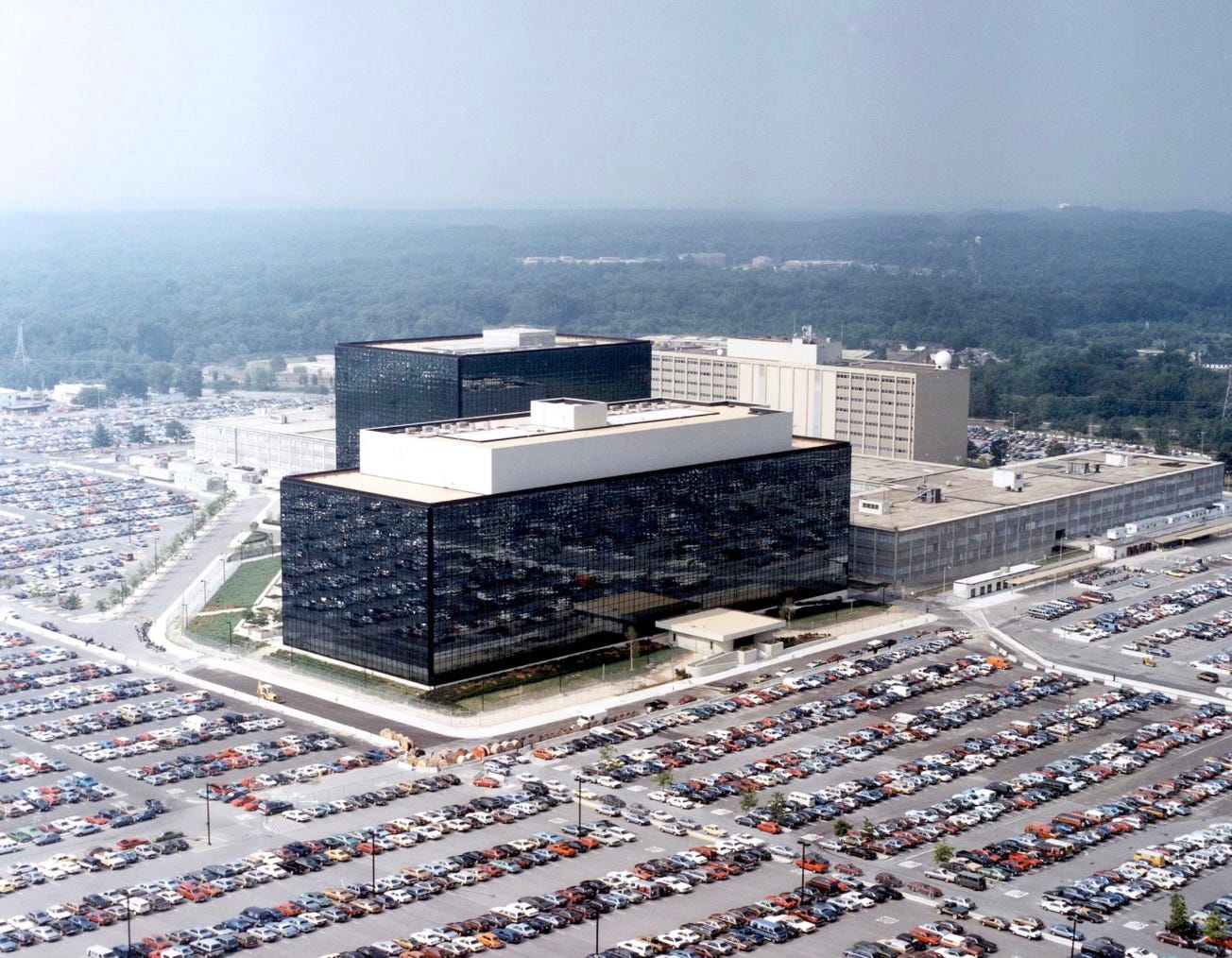

Recently it occurred to me that I should have made a Freedom of Information Act request for the declassification of certain communications intelligence (COMINT) intercepts by the Armed Forces Intelligence Agency (AFSA). I have now corrected that oversight, and am filing a FOIA to obtain certain old decrypted radio intercepts.
The documents in question consist of communications that the U.S. Army’s surveillance spooks overheard as North Korean and Chinese military units discussed the effects of being attacked by U.S. biological weapons (BW) during the Korean War. AFSA was renamed the National Security Agency (NSA) in November 1952. North Korea goes by the official name of the Democratic People’s Republic of Korea (DPRK).
Excerpts from AFSA and NSA radio intercepts were decrypted and analyzed in a series of top secret Central Intelligence Agency (CIA) reports during the war. These were later released into the public domain in 2010. These COMINT excerpts, along with the accompanying CIA analysts’ commentaries, were the source of my 2020 article, “‘A real flood of bacteria and germs’ — Communications Intelligence and Charges of U.S. Germ Warfare during the Korean War,” which was reposted with some editorial emendations at Hidden Histories last December.
When I drafted my FOIA request to the NSA, I revisited the original CIA documents that became the centerpiece of my investigation into the 1950s biological warfare charges. I expected to make a request for 28 raw intercept transcriptions, but as I carefully matched the CIA COMINT reports with each AFSA or NSA file that it was linked to, I saw that there were not just 28 such intercept documents, which would have matched the 28 CIA reports I had found referencing biological warfare. There were thirty-nine!
That’s because approximately one-third of the CIA reports drew upon multiple AFSA/NSA raw intercepts. As a result, the amount of COMINT (or signals intelligence) evidence potentially available to back up the China and the DPRK’s charges of U.S. germ warfare just grew by about 33%.
Yeah…. how could I have originally overlooked that? I can only say that being a researcher is sometimes a humbling experience. My oversight is a good example of why old documents must be read numerous times to ferret out all the information they offer.
“The enemy dropped bacteria”
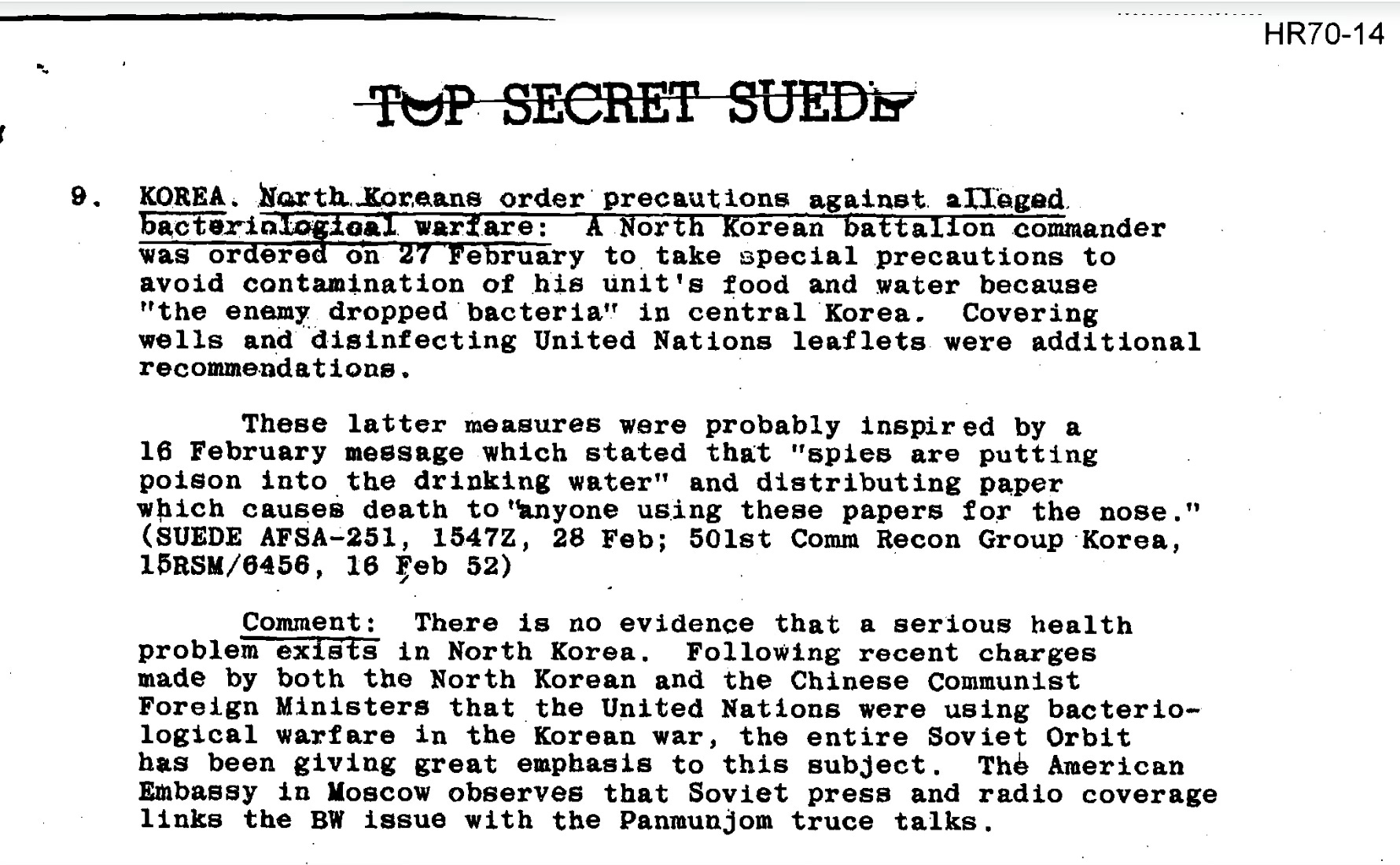
In the screenshot of one of the top secret CIA COMINT reports pictured above, section 9 of the report, dated 29 February 1952, is labelled, “KOREA. North Koreans order precautions against alleged bacteriological warfare.” (Italics are printed as underlined text in the original.)
The CIA’s summary of the report related how a “North Korean battalion commander” had received orders to “take special precautions to avoid contamination of his unit’s food and water because ‘the enemy dropped bacteria’ in central Korea.” In this section I will examine more closely the kind of information in this COMINT report that stimulated my FOIA to the NSA.
The words quoted by the CIA — “the enemy dropped bacteria” — come verbatim from the intercept transcript provided by AFSA to its military and intelligence customers. The same for the other quoted material, e.g. “spies are putting poison into the drinking water.”
The date of the AFSA intercept that stated “the enemy dropped bacteria” was apparently 27 February 1952, as is stated in the report’s text. But, in a parenthetical tag to the section, the CIA detailed the AFSA report date as 28 February. The added day between the intercepted communication and the write up by AFSA can probably be attributed to the need to translate the intercepted communication. It seems logical, then, that the dates for all of the 28 reports I had gathered were for AFSA/NSA’s English translations of the COMINT material.
All the 28 CIA COMINT documents, as well as 11 other contemporary CIA intelligence reports from the Korean War that reference the issue of China and DPRK’s biological warfare charges, are available at this link.
As regards the meaning of the AFSA intercepts quoted in the 29 February CIA report reproduced in part above, the intercepts show that, presumably, the North Korean battalion commander’s military superiors had found it important to notify officers in affected areas that they should be aware of the BW attacks and take appropriate defensive measures.
This is not the time and place to comprehensively analyze the truth value of the intercept material, but it does seem highly unlikely, given the immense strain of a life-and-death battle against the U.S., Republic of Korea, and allied troops, including a massive bombing campaign by the U.S. Air Force, that a battalion commander would be told to waste his time taking “special precautions” for a non-existent BW threat.
Nor is it likely that such communications were performative propaganda displays meant to mislead some ill-defined audience in the West, or convince U.S. and allied troops. For one thing, the Communist military unit or units involved could not even know their communications were intercepted. It is worth noting as well that both Chinese and DPRK military commands put some effort into frustrating U.S. attempts to intercept their communications. Why would they do that if they wanted to be heard, as some sort of means of spreading false BW propaganda? For more reasons pertaining to the authenticity of the COMINT material, I direct readers to the “The Enemy Dropped Bacteria” article mentioned earlier.
The CIA analysts propose in their 29 February report referenced above that the BW precautionary measures were likely “inspired by a message” that AFSA intercepted on 16 February. This earlier intercept described unidentified North Korean or Chinese military personnel notifying unspecified units or officers that “spies” were poisoning “drinking water.” These “spies,” or undercover agents, were also described as “distributing paper which caused death to ‘anyone using these papers for the nose.’”
Agent “X”
It sounds like tissue papers or napkins or other forms of paper had been contaminated with some kind of poison. Given its supposed lethality, I hypothesize it was botulinum, a poison that the U.S. and its ally, Canada, had been experimenting with. The severe disease it produces is well-known as botulism.
Use of botulinum bacteria as a biological weapon was an early project of the U.S. biological warfare program in World War II. I have previously shown that “By 1945, anthrax and botulinus produced at secret facilities in Vigo, Indiana and the Army biological and chemical weapons complex at Camp Detrick, Maryland could ‘fill 500,000 bombs per month.’” Botulinus, the deadly neurotoxin produced by the bacterium Clostridium botulinum, was codenamed agent “X.”
Additionally, in December 1947, top Canadian biological warfare scientist, Dr. Guilford Reed, who research unit worked closely with the Americans, wrote a paper for Canada’s Defence Research Board’s Biological Warfare Research Panel. Entitled “The present position of Bacteriological Warfare - a Brief Review,” Reed bragged that botulinum toxin worked better than any chemical gas.
“Methods have been developed, through pilot plant stage, for the productions of types A and B toxin in semi-purified form… it has a long storage life… Satisfactory air-borne clouds of [botulinum] toxin have been produced in the laboratory and fairly extensive field trials have been carried out with the toxin dispersed from small aircraft bombs.”1
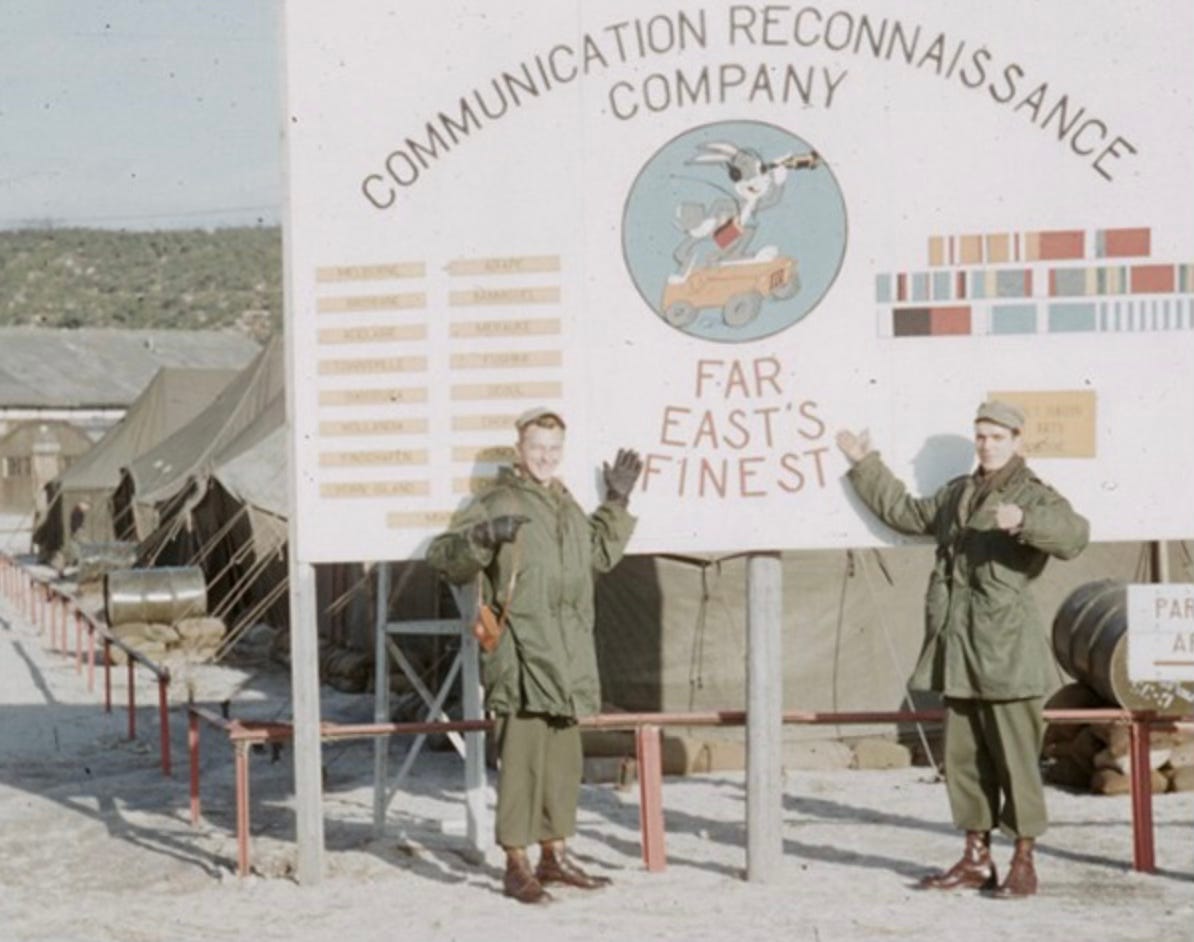
The 29 February CIA report is an example of a COMINT report that drew upon two AFSA intercepts. One was identified as originating from “501st Comm Recon Group [Communications Reconnaissance Group] Korea, 15RSM/6456” on 16 February 1952. This must be the intercept about the spies poisoning water and paper. The other intercept was dated 28 February 1952, and has the identifier “SUEDE AFSA-251, 1547Z.” — “SUEDE” was a top secret, compartmentalized secrecy code. “AFSA-251, I speculate, may have been the name of the AFSA unit involved in the intercept. I don’t know what “1547Z” refers to. In any case, we have here one report, and two intercepts.
A Retrospective Search for Truth
Interestingly, in the 29 February 1952 CIA report I have been examining in detail, the CIA analysts do not deny the Communist BW charges. They only make the observation that, supposedly, there was “no evidence a serious health problem exists in North Korea.” Of course, these analysts cannot really know the health status across all of North Korea during the war. My guess is that this is what the analysts were told or briefed.
Yet only months before, on 30 March 1951, an anonymous military source told Associated Press that ‘soldiers and civilians in Red Korea are dying by the thousands of smallpox, typhus and typhoid.... putting far more Red soldiers out of action than United Nations shells and bombs.’”
The latter charge sounded like absurd propaganda when I first read it, and it likely was. My point is that with U.S. information swinging wildly when it came to the documentation of disease in North Korea during the period of alleged biological warfare, it is very difficult to parse out exactly what the effect of the BW campaign was. Analysis of that would likely have taken months, and the results kept closely guarded by select units of the Air Force and the U.S. Army Chemical Corps. Hence, a retrospective search for the truth of what was going on can only be enhanced by getting copies of the relevant raw intelligence data, now 74 years old.
As I explained in my FOIA request letter to the NSA, there is a precedent for releasing such raw intelligence intercepts. In 1994, historian Richard Breitman, in an effort to more fully document Germany’s extermination campaign against European Jewry, and other victims, made a FOIA request for “all German records decrypted [decoded] by the Allies and still held by NSA.” Ultimately, as a result of this request, “some 1.3 million pages of material stored in 1,440 large archive boxes” were declassified and released to the National Archives in College Park, Maryland, including the formerly classified radio decodes.
The newly declassified material was very helpful in understanding how the Holocaust unfolded, and the role of the German Order Police (Ordnungspolizei) in the massive killing campaign. It also demonstrated that United Kingdom and U.S. officials had a good idea of what the Germans were doing as regards the Jews from quite early on. See Richard Breitman, Official Secrets: What the Nazis Planned, What the British and Americans Knew, Hill and Wang, New York, 1998, pgs. 236-237.2
Given the glacial response to government FOIA requests from spy agencies these days, I wish I had made my request on the AFSA/NSA intercepts back when I started the Korean War BW research project. Who knows if I will even still be around this world when the request gets fulfilled — if it gets fulfilled. But I am fairly sure that there is still much to be found in unreleased and still classified material from the Korean War period.
When Breitman began his own FOIA request in the late 1990s, the still classified Nazi World War II documents he sought were themselves already over 50 years old! My FOIA request is for documents now 74 years old. It is difficult to know why any of it should be classified at all.
I have never made a FOIA request to the NSA before. Perhaps I will be pleasantly surprised. I have had some good luck with FOIA requests over the years, and some not-so-good luck. Part of the fun (and sometimes, frustration) of doing this usually oh-so-serious research is seeing how such interactions with government agencies unfold.
Evidentiary Significance
Astute critics of my work have pointed out to me that the CIA COMINT documents, and possibly the intercepts they are based upon, are not conclusive evidence of U.S. use of biological weapons in the Korean War. But these critics never address this evidence in the context of a welter of corroborating evidence accrued over the years, for which the COMINT documents, and hopefully the originating intercepts upon which they are based, are really the cherry on top of the evidence sundae.
The corroborating evidence for U.S. use of biological weaponry during the Korean War includes: the March 1952 “Report of the Commission of the Medical Headquarters of the Korean People’s Army on the Use of Bacteriological Weapons”; the information and witnesses examined by a group sent by the International Association of Democratic Lawyers in March 1952; an extensive examination of evidence and witnesses undertaken by the International Scientific Commission, led by British scientist Joseph Needham, which visited DPRK and China in summer 1952; statements by FBI officials; statements by UK BW officials; the 5 April 1952 report from the headquarters of the Chinese People’s Volunteer Army, “Concerning the Comprehensive Situation of the Enemy’s Bacterial War and Use of Poisonous Gas, 28 January to 31 March 1952,” portions of which were reproduced in Stephen Endicott and Edward Hagerman’s 1998 book, The U.S. and Biological Warfare: Secrets from the Early Cold War and Korea (and in an article I posted awhile back); statements by U.S. flyers published by the People’s Republic of China; and much, much more.
On the other hand, what is the evidence against use of BW by UN forces? There are many official U.S. denials. In addition, there are both alleged Soviet and Chinese documents that claim to have uncovered a conspiracy to falsify biological weapons attack. These documents were examined by two U.S. Cold War scholars, Milton Leitenberg and Kathryn Weathersby, and the rather incurious media and small-time academics have acted as an echo chamber for these scholars’ claims.
I recently published a three-part series that analyzed the alleged Soviet and Chinese documents (Part One, Part Two, Part Three). While I can never know if Leitenberg and Weathersby and their followers published their BW “debunking” essays because they believed in their own biased opinions, or because they were purposely disingenuous, or some other reason, the fact remains that the documentary record they propound was gravely flawed.
For one thing, their documents lacked provenance. In fact, only one person has ever seen the original Soviet documents that claim a conspiracy to falsify BW attack. But even if authentic, the documents’ claims are self-contradictory, often preposterous, lack internal and external validity, and are at odds with other available evidence from contemporary sources, such as newspapers of the time, or now declassified government documents.
To this day, neither Leitenberg nor Weathersby, nor any historian or journalist citing their work positively, has ever addressed the evidence I (and, separately, author Nicholson Baker) have put forward in relation to the COMINT reports. That’s not just an oversight — it’s deliberate obfuscation.
The fact that there appear to be 39 AFSA/NSA intercepts — at a minimum — adducing U.S. use of biological weapons against China and North Korea stimulated an amusing association for me. The number “39” recalled for me the great Hitchcock spy film, “The 39 Steps.” As a treat for my readers, below is a link to watch the final minutes of the film, when “Mr. Memory” answers the fatal question, “What are the 39 Steps?”
My question for the NSA is: “What’s in the 39 intercepts?”
Quoted material from Stephen Lyon Endicott archive at York University Archives & Special Collections, York University, Toronto. See 2018-016 / 005 (10) RG 24: Dept. of National Defense; RG 24F: Defense Research Board; RG 25: Dept. of External Affairs -Important Canadian documents on biological warfare 1948-1952 (Declassified 1997) PART 2 OF 4, Stephen Lyon Endicott fonds, F0667. The quote appears on pg. 5 of Reed’s report.
While Breitman concentrated mainly upon the SS-Ordnungspolizei links in his book, as documented in the declassified intercepts he obtained, he does briefly touch upon the role the Germany Army played in the massive killing on the Eastern front. There is even an example of the Army’s role in the gassing of Russian hospital patients so the Army could obtain the hospital buildings for quartering its officers or troops. (See pg. 99 of Official Secrets.) Unfortunately, the book does not go into much detail about the actions of the Wehrmacht, or the vicious campaign to starve or otherwise kill millions of Soviet POWs. The latter remains an area of relative neglect in Western, or at least English-language accounts of the Holocaust. In the case of Breitman, I think that is at least an artifact of the material that he had discovered and was analyzing for his book, i.e., the Police Order intercepts.
Brilliant archival detective work uncovering these additional COMINT sources. The fact that one-third of the CIA reports pulled from multiple intercepts really expands the documentary base here. I worked ona similar project diging through old State Dept cables once and its wild how much you miss on first read. The botulinum angle is particularly compelling given Reed's pilot plant work at Detrick.
I doesn't surprise me, and more that we will see!!!